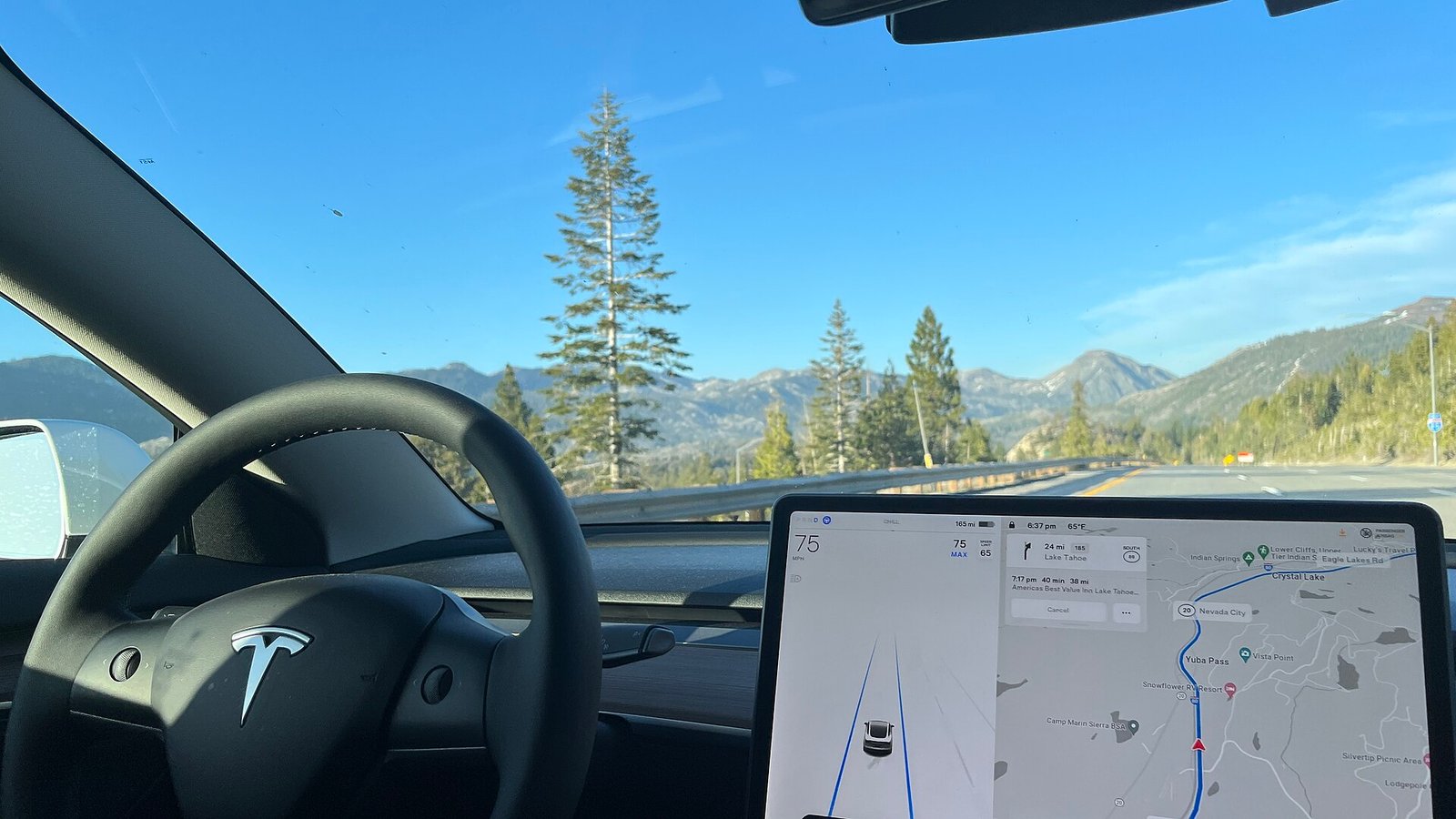
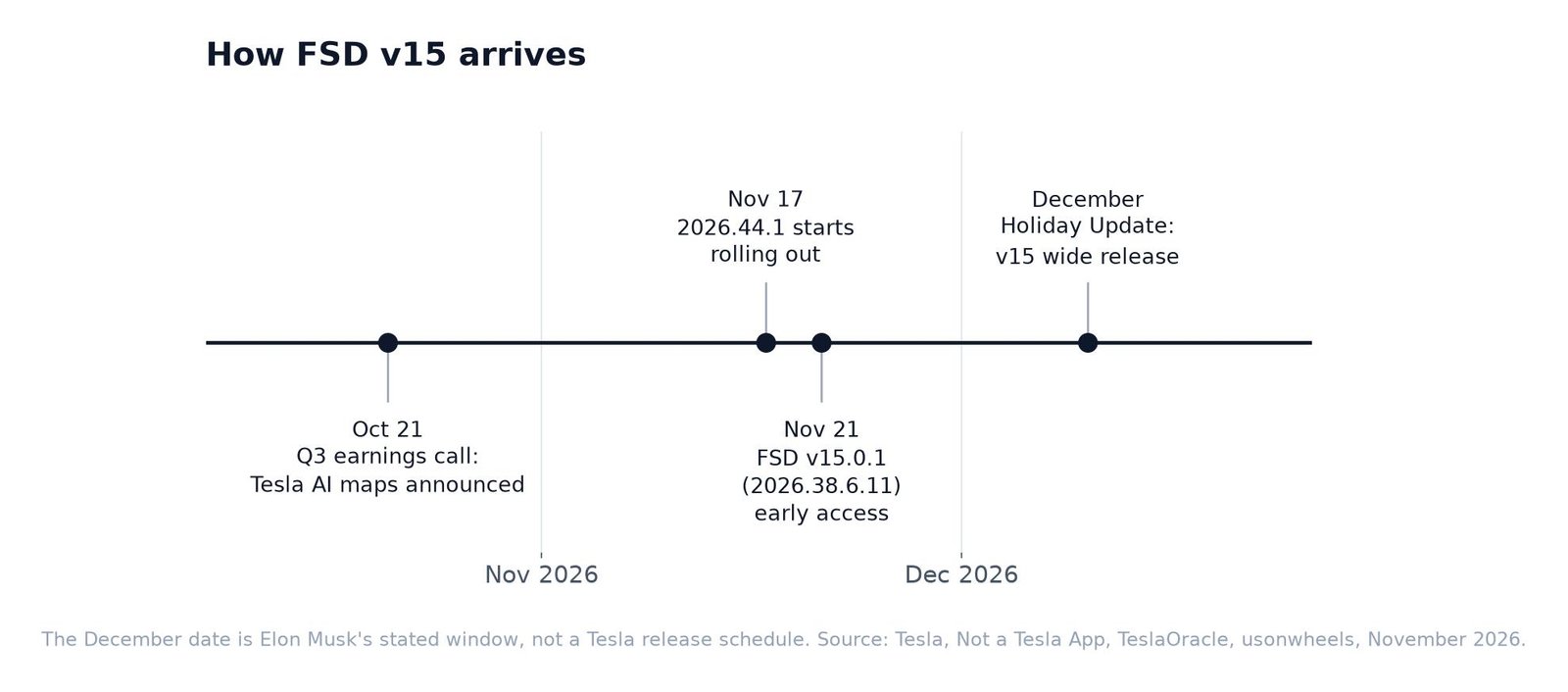
On Saturday, November 21, Tesla posted that FSD v15 was “now starting to roll out.” By that evening, owners in New York and elsewhere in the US were posting screenshots of software 2026.38.6.11 installing on 2026 Model Ys, and the version number on the car read FSD (Supervised) v15.0.1.
That is not the wide holiday release. Tesla’s AI chief called it “the first wave,” and by Tesla’s own early sightings every install so far has been a Model Y on HW4 in the United States. The wider release is now a December story, tied to the annual holiday update.
Still, this is the first time anyone outside Tesla has been able to read the real notes for v15. And the notes are more interesting than the version number suggests — not because of the headline features, but because two of them quietly close gaps owners have complained about for two years.
The short version
1. FSD v15.0.1 (2026.38.6.11) went to early access on November 21. So far: HW4 Model Ys in the US only.
2. Wide release is expected in December with the Holiday Update — Musk’s words, not a Tesla schedule. HW3 cars are not getting v15; they stay on v14.3 Lite.
3. The features to watch are Tesla Reality View, speed-camera slowdown, and the first piece of Tesla’s own AI mapping at the start and end of a trip.
What is actually in the release notes
Tesla’s notes are written in the company’s usual shorthand, which assumes you already know what every phrase means. Here they are translated, with the part that will matter to a driver.
| Feature | What it means in the car | Hardware |
|---|---|---|
| New vision encoder | One model now shared by FSD, Robotaxi and Optimus, trained on millions of internet videos. Tesla claims a 25x better critical intervention rate. | HW4 |
| Tesla Reality View | A live, generated view from a virtual camera above the car, showing what FSD is about to do. Full screen, map, split or quiet mode. | HW4 |
| AI navigation | Start and end of the trip are now routed by a model trained on fleet route preferences. Later v15 releases extend it to the whole route. | HW4 |
| Parking options | The map shows multiple parking choices at your destination, ranked with your own parking history. | HW4 |
| Speed camera slowdown | The car slows for a detected speed camera. Accelerate or raise the speed profile to override; two overrides at the same camera save an exception. | HW4 |
| Bike Rack Mode | FSD and Autosteer can be engaged with a bike rack or hitch accessory fitted. The car pulls over near your destination and does not reverse. | HW4 |
| Driver monitoring | Attention monitoring now works with hats and sunglasses, and is less strict in the higher-speed profiles. | HW4 |
| Detection and comfort | Better detection of signs, small animals, debris, chains, potholes and deep standing water; smoother speed in school zones and bad weather; Autoshift tied to FSD gear predictions. | HW4 |
| Release notes for 2026.38.6.11, published November 21, 2026, as reported by Not a Tesla App, Teslascope, Teslarati and TeslaOracle. | ||
Reality View is the one to watch
The old visualization drew a simplified world out of a stack of separate model outputs — lanes here, cars there, a path line on top. Reality View throws that away and renders the scene end to end from the camera images.
Ashok Elluswamy, Tesla’s VP of AI, described it as “pixels in, pixels out.” Musk’s version was that it does not use a game engine and runs on about half of one AI4 accelerator. Whether or not those numbers hold up in the car, the direction is clear: Tesla is trying to show the driver the model’s own understanding of the road rather than a hand-drawn cartoon of it.
The practical bits are in the details. Upcoming navigation turns now appear inside the driving view instead of only on the map panel. You can pick full screen, map, split view, or “quiet mode” that tones the whole thing down. Turn signals fade out after a few clicks instead of chirping forever.
Speed cameras and bike racks: the two features that change daily use
The speed camera behaviour is smarter than it first sounds. The car slows when it detects a camera. If you do not want that, you press the accelerator or raise your speed profile and it cancels. If you cancel twice at the same camera, the car remembers the location and stops slowing there. Exceptions are cleared under Controls > Service > Manage Saved Locations.
Bike Rack Mode is the one owners of hitch racks have wanted since Autopilot first refused to engage with a rack fitted. With the mode on, FSD engages normally, but the car pulls over near your destination and will not reverse. Autopark, Summon and the backup chimes are disabled, which makes sense: the rear camera view is a bicycle.
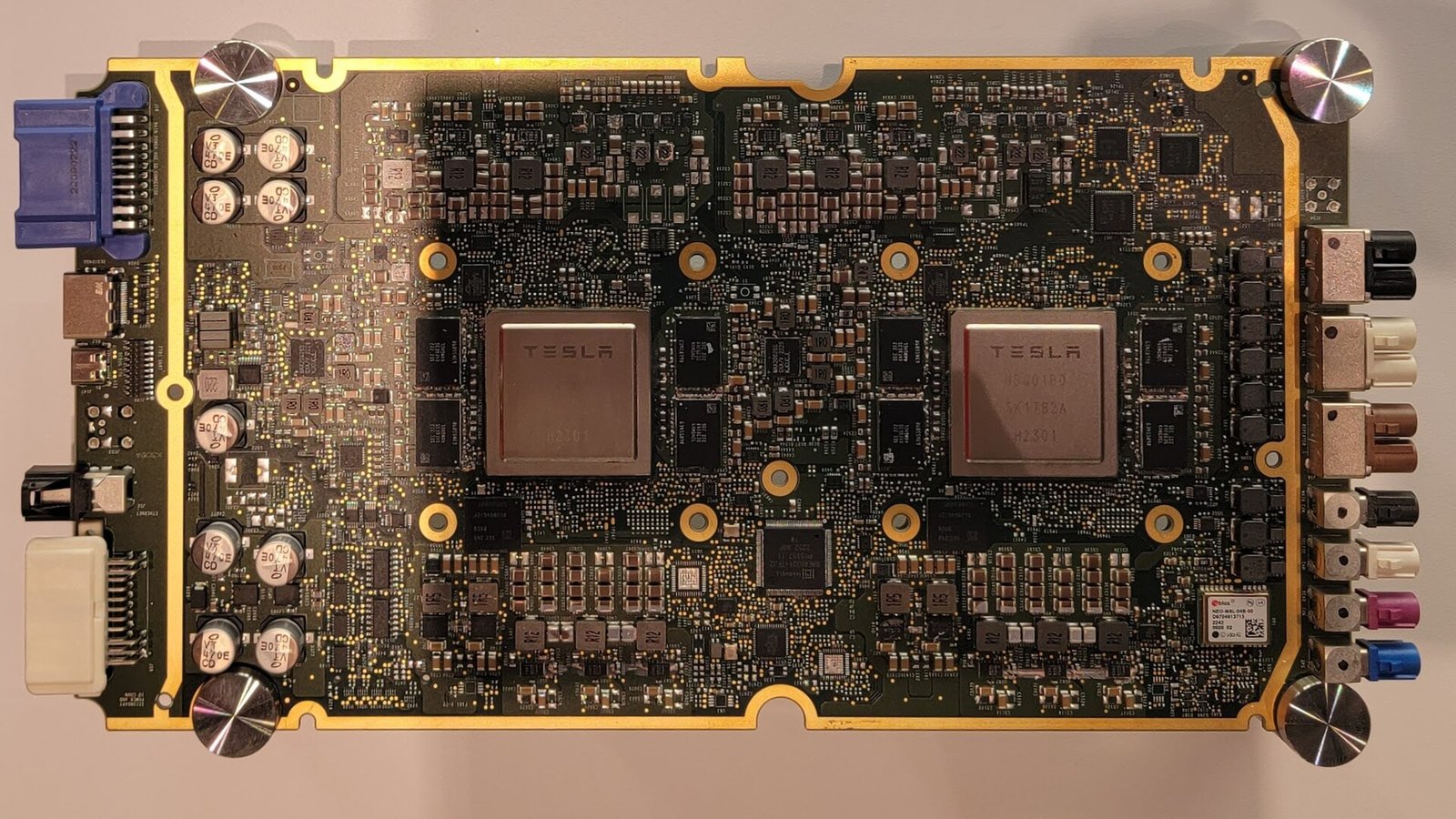
The 25x claim, and why I would not quote it as a fact
Tesla says the new encoder improves “the critical intervention rate by 25x.” That is the kind of sentence that ends up in every headline, and it is worth slowing down on.
Tesla has not published the baseline it multiplied. Automotive World pointed out the obvious problem on November 23: without the number behind the multiplier, nobody outside Tesla can check it. Crowdsourced owner data suggests FSD v14 was managing something like a couple of thousand miles between critical interventions. Multiply that by 25 and you land around 50,000 miles.
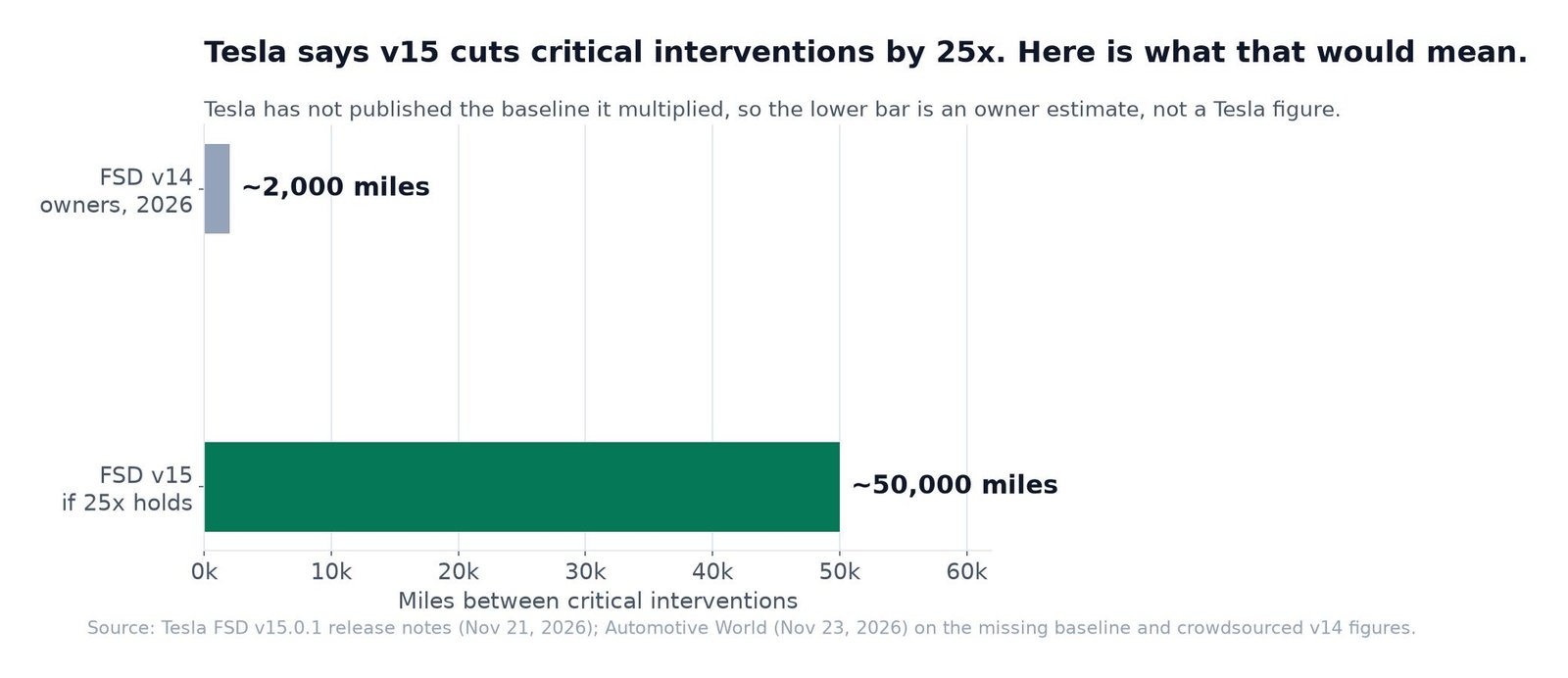
That is a big number, and it is exactly the kind of number that gets repeated until it becomes a fact. I would treat it as a direction of travel. The release notes describe real changes — potholes, standing water, school zones, animals, debris — and those are the things that produce interventions. Whether the result is 25 times better or three times better will be settled by the first thousand owners, not by a slide.
Where the AI maps come in
The most important part of v15 is not in the release notes at all. It is an answer Ashok Elluswamy gave on Tesla’s third-quarter earnings call on October 21, when a shareholder asked why Tesla still relies on third-party maps and pointed at speed limits, parking and route choice as the three biggest problems.
“You’re totally right that we shouldn’t be depending on external people’s maps,” he said. “We are building our own maps,” but not in the style of OpenStreetMap — “an entirely new architecture with essentially AI-based mapping and navigation,” integrated with voice, learning both your own preferences and the fleet’s. The start and end of trips would use it “pretty soon as part of the v15 release,” with parking and destination handling following over the next several months.
Then look back at the release notes: navigation for the start and end of the trip now comes from a learned model, and the map shows multiple parking options at your destination ranked by your own history. That is the first visible piece of the thing he described.
It also explains the limitation. The shareholder suggested letting trusted owners submit corrections; Elluswamy described a system that learns from fleet data instead. Tesla did not say on the call how much external map data remains in the stack, and it has not said it since.
HW3 owners: v15 is not coming
This is the part that will disappoint the largest group of owners. FSD v15 is for AI4, also called HW4. Cars on Hardware 3 are not in the release notes, and the current software for them is FSD v14.3 Lite.
The distinction showed up a few days earlier in the 2026.44 branch, which started rolling out on November 17 as 2026.44.1. That build carried FSD v14.3.13 for HW4 cars, v14.3 Lite for HW3 cars, and Automatic Collision Evasion on HW4. The holiday update has historically come from the .44 branch, which is another reason to expect v15 to arrive as a .44 point release rather than a separate download.
Tesla has previously said the AI4 computer is enough to run v15. It has not said what HW3 owners get instead beyond Lite builds, and it has not offered an upgrade path. If you are shopping for a used Tesla specifically for FSD, the hardware generation in the car matters more than the year on the registration.
What I would do before the December release
Check your hardware, not your hopes. Controls > Software will tell you which computer the car has. If it says AI3 or HW3, v15 is not in your future this year.
Do not subscribe for v15 yet. FSD is $99 a month after a one-month trial, and the early build is going to a hand-picked group. If v15 is the reason you would pay, wait for the wide release and for the first independent drives. A month of subscription buys you the v14.3 build your car already has.
Watch for the map change, not the graphics. Reality View will get the attention because it looks like a video game. The thing that will actually make FSD better on your commute is the routing and parking behaviour, and that is the part Tesla says will roll out over months, not days.
Version 15 is the first FSD release in a while that reads like a list of owner complaints rather than a demo. Potholes, standing water, school zones, bike racks, speed cameras, sunglasses. None of it is glamorous. All of it is the difference between a system you supervise and a system you stop using.
Sources: Tesla’s FSD v15.0.1 release notes (2026.38.6.11, November 21, 2026) as published by Not a Tesla App, Teslascope, Teslarati and TeslaOracle; Tesla’s Q3 2026 earnings call transcript (October 21); Automotive World (November 23); TeslaNorth and usonwheels on the 2026.44 branch and holiday update, November 2026.
Header photo: Natecation, CC BY-SA 4.0, via Wikimedia Commons.
Free · weekly
Get the EV spec sheet
One email a week: real-world range, charging curves, and running costs for the EVs people actually buy, compared side by side.
Free, no spam. Unsubscribe in one click.