
A reader wrote in last week with the spreadsheet attached. He had done the usual thing: Model Y price minus RAV4 price, divided by the fuel saving, and come out with a payback of “about two years.” He wanted me to check his work before he signed.
The arithmetic was fine. The problem was that he had left out two lines that are bigger than the fuel saving, and both of them land on the Tesla.
So here is the whole bill, run properly with prices checked on November 26, 2026: what the two cars cost to drive away, what five years and 75,000 miles actually adds up to, and the three numbers that decide which one wins for you. The answer is not what the marketing says, and it is not what the anti-EV crowd says either.
The two cars, as they are priced today
I am comparing the cheapest version of each, because that is where most of these decisions actually happen. Both are five-seat, two-row crossovers with a hatch, and both are the version most people actually price.
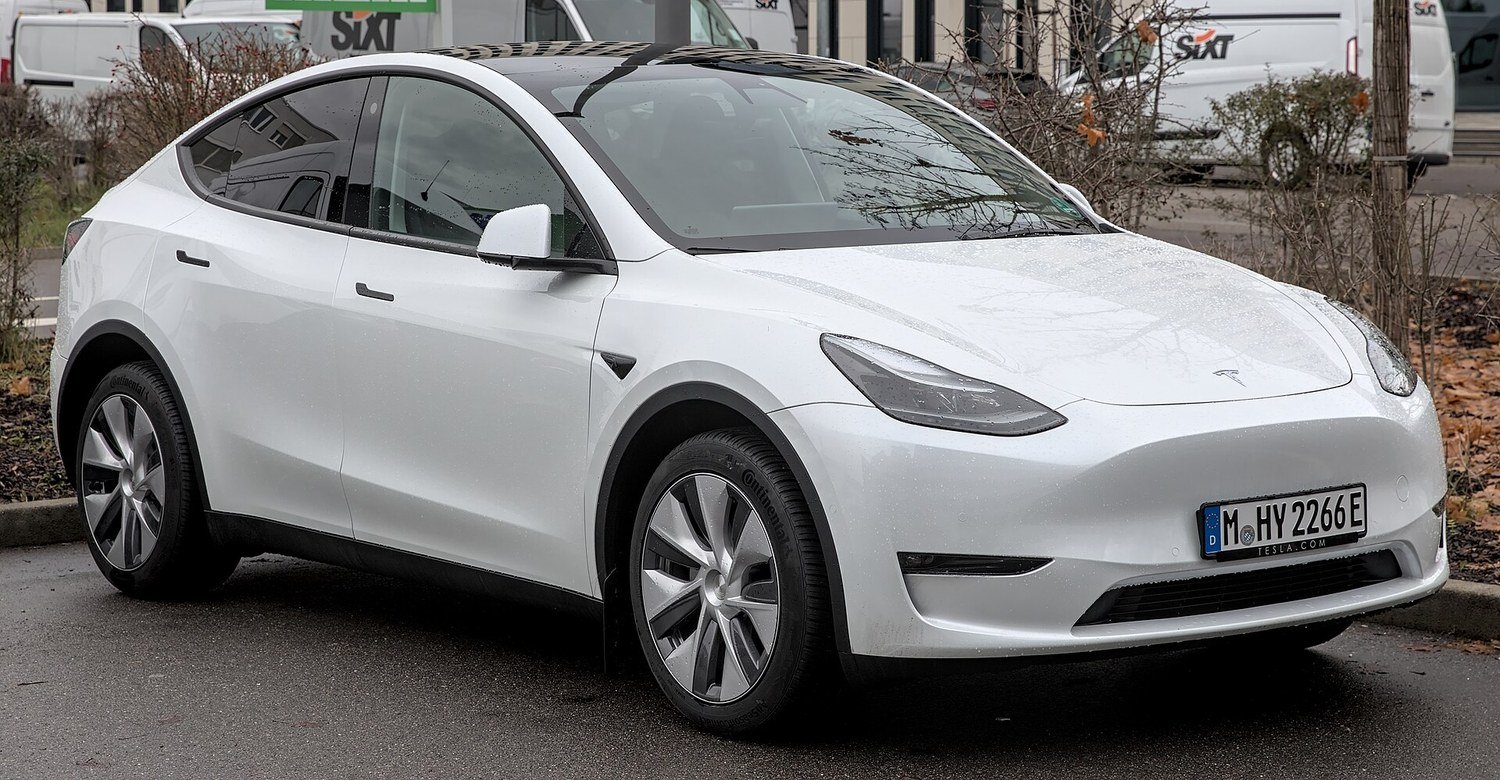
The Tesla side is the Model Y rear-wheel drive Tesla is selling right now: $39,990, 348 miles of EPA-estimated range, 25.0 kWh per 100 miles. The EPA files that exact combination under model year 2027. Tesla adds $1,640 in destination and order fees, so it is $41,630 before tax and registration.
The Toyota side is the 2027 RAV4 LE, which is the new sixth-generation car and now hybrid-only: $32,300 plus Toyota’s $1,595 delivery, processing and handling fee, so $33,895. Toyota rates it at 46 city and 40 highway mpg; the EPA’s combined figure for the same powertrain is 43.
| Tesla Model Y RWD | Toyota RAV4 LE (hybrid) | |
|---|---|---|
| Base price | $39,990 | $32,300 |
| Delivery and fees | $1,640 | $1,595 |
| Before tax | $41,630 | $33,895 |
| Efficiency | 25.0 kWh/100 mi | 43 mpg combined |
| Rated distance | 348 mi (electric) | 43 mpg, any gas station |
| Included maintenance | none | ToyotaCare, 1 yr / 10,000 mi |
| Federal tax credit | none (ended Sept 30, 2025) | none |
Two things worth saying out loud, because you will see both misreported. There is no federal EV credit on either car any more — Section 30D stopped applying to vehicles acquired after September 30, 2025. And the home-charger credit (30C) ended June 30, 2026, so the $635 wall connector you may need is full price.
Also note the ToyotaCare change: for the 2027 model year it is one year or 10,000 miles. Cars from 2026 and earlier got two years or 25,000. That quietly moved about one service visit from Toyota’s column into yours.
What 100 miles costs, which is where the Tesla wins
This part is real, and it is bigger than most people expect. The Model Y uses 25 kWh to go 100 miles; at the US average residential price of 18.17 cents, that is $4.54.
The RAV4 needs 2.33 gallons of regular to do the same 100 miles. At $3.642 a gallon it is $8.47, or about 87% more.
Then you add the part everyone skips: 20% of your charging, realistically, happens in public. Superchargers averaged $0.649/kWh in November 2026, so a diet of 80% home and 20% public puts the Model Y at $6.88 per 100 miles — only $1.59 ahead of the hybrid.
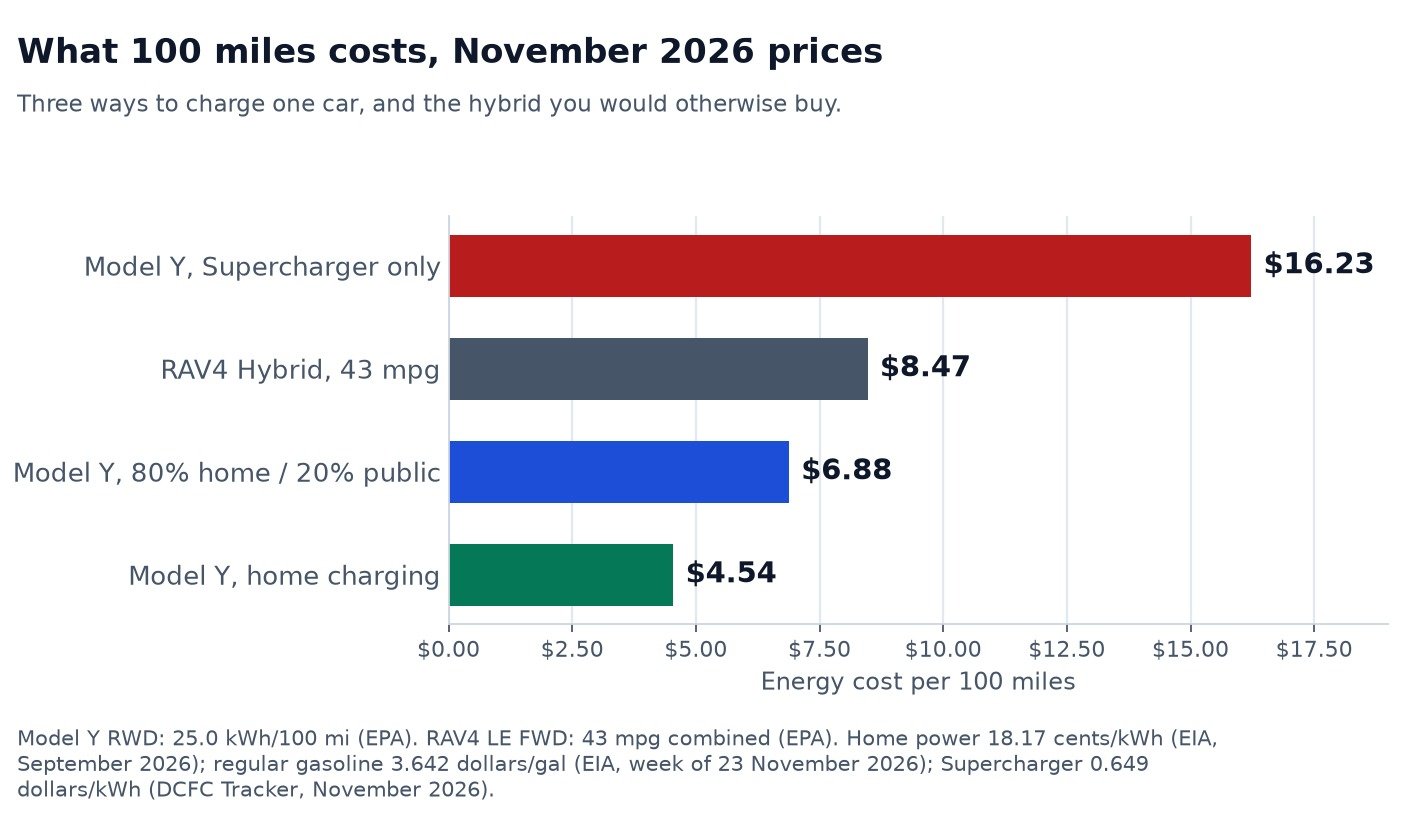
And if you cannot charge at home at all — an apartment, a street with no outlet — the Model Y becomes the most expensive car on this page by a wide margin. $16.23 per 100 miles, which is $2,434 a year against the Toyota’s $1,270.
I went through the home-versus-public split in detail in the charging cost piece earlier this month. The short version: the cable, not the car, is the deciding input.
Now the part that actually decides it
Over five years and 75,000 miles, at 80/20 charging, the Model Y burns $5,159 of electricity and the RAV4 burns $6,352 of gasoline. The Tesla is $1,193 ahead. At home charging every night, it is $2,945 ahead.
Then you add depreciation, insurance, maintenance, and the wall connector, and the sign flips hard.
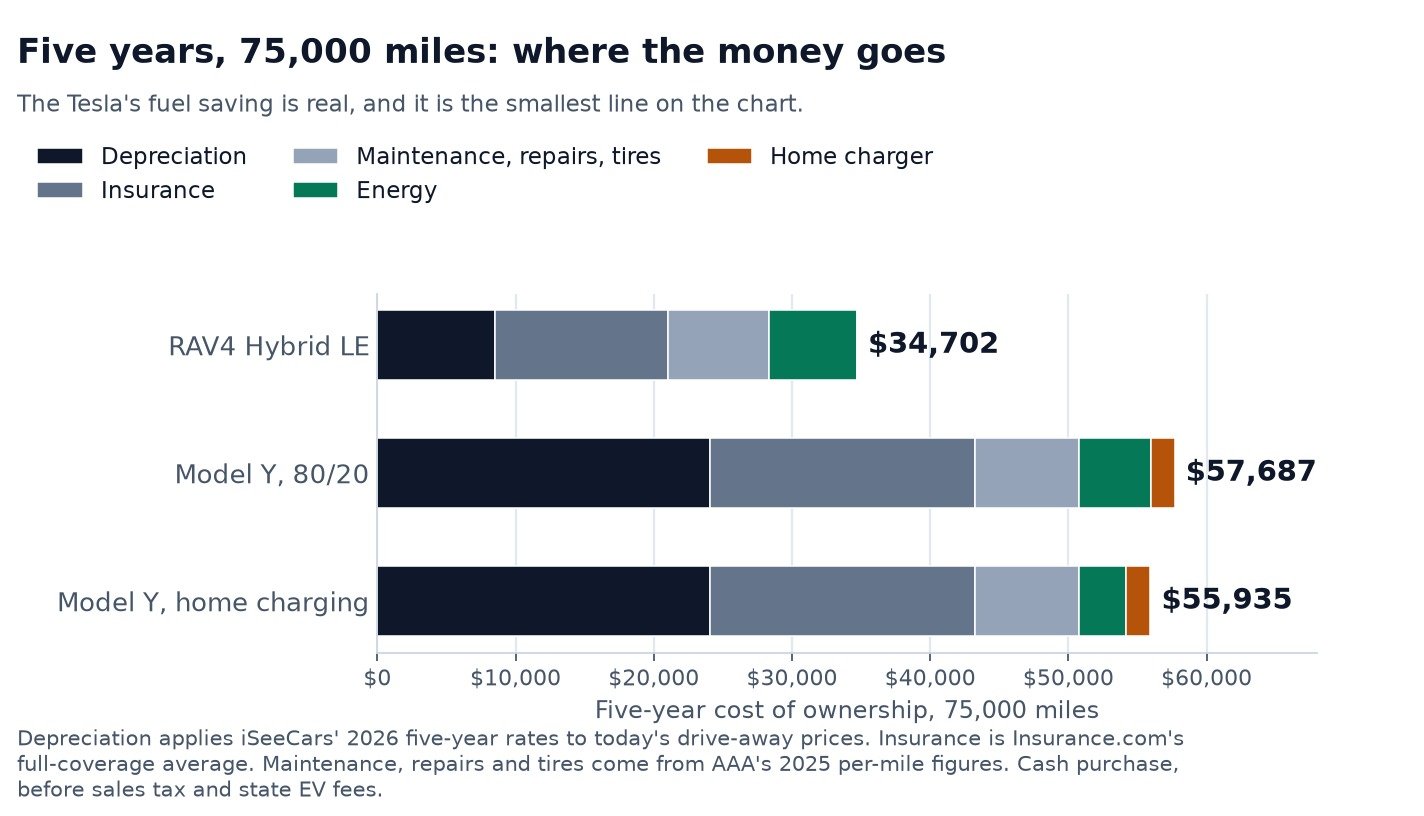
| Five years, 75,000 mi | RAV4 LE | Model Y home |
Model Y 80/20 |
Model Y public only |
|---|---|---|---|---|
| Depreciation | $8,542 | $24,062 | $24,062 | $24,062 |
| Insurance | $12,495 | $19,180 | $19,180 | $19,180 |
| Maintenance, tires | $7,313 | $7,553 | $7,553 | $7,553 |
| Energy | $6,352 | $3,407 | $5,159 | $12,169 |
| Home charger | — | $1,733 | $1,733 | — |
| Total | $34,702 | $55,935 | $57,687 | $62,964 |
Read that bottom row again. The Model Y is $21,200 to $23,000 more expensive over five years, and if you charge entirely in public it is $28,300 more.
Three independent estimators agree on the direction. Edmunds’ True Cost to Own puts the 2026 Model Y base trim at $54,247 and a 2025 RAV4 Hybrid LE AWD at $39,417 — a $14,830 gap, smaller than mine but the same verdict. CarEdge’s model has the Tesla $29,000 apart from the RAV4. My number sits in the middle.
Depreciation is the whole argument
The largest single line is not fuel, and it is not maintenance. It is the value the car loses while you own it.
iSeeCars’ 2026 study of 950,000 five-year-old used cars found the RAV4 and RAV4 Hybrid keep 74.8% of their value — ninth-best of every vehicle sold in America. The Tesla Model Y keeps 42.2%, fourteenth-worst. Among EVs, only the Model 3 does better.
On our two stickers that is $24,062 gone on the Tesla and $8,542 on the Toyota. A $15,521 head start that no amount of home charging closes.
Why so lopsided? Tesla spent 2023 and 2024 cutting new-car prices by five figures, and every cut dragged the used market down with it. Toyota spent the same years with a waiting list. That is a two-year-old story, and the used market has partly absorbed it, but the five-year cohort being sold right now still carries the mark.

I would argue hardest with this number if I were you. If you plan to keep the car eight or ten years, the percentage matters less than the dollars, and the dollars stop moving once the car is worth very little. At ten years iSeeCars measures 78% depreciation on the Model Y and 54% on the RAV4, which is $32,500 against $18,100 — roughly the same gap, spread over twice as long.
Insurance, the quiet line
Insurance.com’s quote-based averages, same driver profile, same coverage: $3,836 a year for the Model Y and $2,499 for the RAV4 Hybrid. That is $6,685 over five years, for two cars that sit in the same parking space and drive the same roads.
The reason is not mysterious. A Model Y is worth more, so a total loss costs more. Its body panels and battery pack need Tesla-certified shops, which are fewer and slower. And actuaries price the acceleration.
This is also the line where the estimates disagree most. Edmunds’ TCO uses $1,377 a year for the Model Y and $1,084 for the RAV4 — a gap of only $293 a year. If Edmunds is right where you live, the five-year gap shrinks by about $5,200. Get a real quote on both cars with your own ZIP code before you take either estimate seriously; it is a ten-minute phone call that moves the answer by thousands.
Maintenance, where the EV story gets complicated
Everyone knows the EV pitch: no oil changes, no spark plugs, regenerative braking saves the pads. All true. Also, AAA’s 2025 Your Driving Costs study — which counts scheduled service, repairs and a set of replacement tires — puts EVs at 10.07 cents a mile and hybrids at 9.75 cents.
The hybrid is cheaper. By 0.32 cents a mile, which is $240 over five years, which is nothing. But it is not the EV walkover people expect.
The reason is tires. A Model Y weighs over two tons and puts all its torque down at zero rpm; its 18- and 19-inch tires are expensive and do not last as long as the 17s on a RAV4 LE. Toyota’s hybrid also has the easier service book — long service intervals and, for 2027, a year of free scheduled maintenance.
My advice: treat maintenance as a wash and stop using it as a tiebreaker. It isn’t one.
The fee at the DMV that nobody puts in the spreadsheet
Most states now charge electric cars an annual fee to replace the gas tax they don’t pay. It is not small, it is not optional, and it does not appear in any of the sticker comparisons.
| State | EV fee / yr | 5 years | Hybrid fee |
|---|---|---|---|
| New Jersey | $270 | $1,350 | — |
| Michigan | $267 | $1,335 | $117 |
| Georgia | $238.59 | $1,193 | — |
| Texas | $200 | $1,000 | — |
| Ohio | $200 | $1,000 | $100 |
| California | $121–$175 | $605–$875 | — |
| Colorado | $89.05 | $445 | $38.25 |
| Minnesota | $75 | $375 | — |
| Hawaii | $50 | $250 | $50 |
In Texas it is $200 a year on top of normal registration, and a new EV pays $400 in its first year. Remember that the Tesla’s entire five-year fuel advantage at 80/20 charging was $1,193. The fee takes $1,000 of it back.
In Georgia the fee is $238.59 a year, and the Tesla’s energy advantage at 80/20 charging is $238.60 a year. The state takes all of it. Go look up your own state before you build a budget on the fuel saving — the numbers are in the National Conference of State Legislatures’ table, updated in July 2026.
Does more driving ever flip it?
The obvious objection: I don’t drive 15,000 miles, I drive 25,000. Fair. Here is the same comparison across mileage, holding depreciation at the five-year rate.
| Model Y charging | 10,000 mi/yr | 15,000 mi/yr | 25,000 mi/yr |
|---|---|---|---|
| Home every night | +$22,213 | +$21,233 | +$19,265 |
| 80% home / 20% public | +$22,588 | +$22,986 | +$20,203 |
| Public only | +$26,325 | +$28,262 | +$32,145 |
Positive numbers mean the Model Y costs more than the RAV4 over five years. Doubling your miles pulls the gap in by about $2,000. It does not come close to closing $20,000.
And the top row is the optimistic one: a five-year-old Tesla with 125,000 miles depreciates harder than the 75,000-mile assumption behind that number, so real-world depreciation makes the gap wider, not narrower.
To put the scale in one sentence: at 15,000 miles a year with home charging, the Tesla’s fuel saving is $589 a year, and the depreciation plus insurance gap it has to overcome is $4,441 a year.
So who should actually buy the Tesla?
Me, in some years, and probably not for the fuel. Here is how I would split it.
Buy the RAV4 if you keep cars four to six years, rent, or have any doubt about installing a charger. The math does not ask you to like it. It also happens to be a genuinely good car, which makes this an unusually easy recommendation.
Lease the Model Y if you want the Tesla and change cars often. Depreciation is the biggest line in the table, and a lease hands it to the finance company. This is the single most useful thing I can tell you about buying a Tesla right now: the purchase math and the lease math are not the same decision.
Buy a used Model Y if you want to own one. The first owner has already eaten the $24,000 haircut. A four-year-old Model Y with the battery and drive-unit warranty still running is the version of this car where the numbers stop embarrassing themselves — and where the fuel saving finally counts for something.
Buy a new Model Y anyway if you have a garage, drive a lot, keep cars until the wheels fall off, and value the things the spreadsheet cannot see: no dealership, no oil changes, software that improves, 348 miles of range you top up at home, and the Supercharger network on road trips. Those are real. They are just not worth $20,000 to everyone.
FAQ
Is the Tesla Model Y cheaper to own than a RAV4 Hybrid?
On five years and 75,000 miles, no — not at November 2026 prices. It saves $1,193 to $2,945 in energy and gives back $15,521 in depreciation, $6,685 in insurance, and $1,733 for the home charger. The gap is roughly $21,000 with home charging and $28,000 charging only in public.
How much does 15,000 miles cost in electricity?
About $681 a year at the US average home rate of 18.17 cents/kWh, $1,032 in an 80/20 home-and-public mix, and $2,434 if every mile is Supercharged. The same distance in a 43-mpg RAV4 costs $1,270 at $3.642 a gallon.
Why does the Model Y depreciate so much?
Tesla’s 2023 and 2024 price cuts reset what buyers would pay for a used one. iSeeCars puts five-year depreciation at 57.8% for the Model Y against 25.2% for the RAV4 line. The EV segment average is 57.2%, so this is a category problem as much as a Tesla one.
Is insurance really that much more?
Depends who you ask. Insurance.com’s quote data says $3,836 a year versus $2,499 for the RAV4 Hybrid. Edmunds’ TCO model says $1,377 versus $1,084. The direction is consistent, the size is not. Get two quotes before you decide.
Do I still get a federal tax credit in 2026?
No. Section 30D stopped applying to vehicles acquired after September 30, 2025, and the Section 30C home-charger credit ended June 30, 2026. State and utility programs still exist, and they are worth checking — some are worth thousands.
What if I keep the car ten years?
The fuel saving compounds and the depreciation gap stops growing, but it does not disappear: iSeeCars measures 78% depreciation on the Model Y at ten years and 54% on the RAV4. Insurance is the line that decides it, and insurance gets cheaper as a car ages — which is the argument for buying the used one.
Does winter change the math?
It costs the Tesla more. Cold reduces range and raises consumption, and a hybrid loses efficiency too but keeps its gas engine as a backstop. If you live somewhere with a real winter, add 15–25% to the Model Y’s energy line and subtract a little from its rated range.
Sources
Tesla — US design studio for Model Y (RWD $39,990, 348 mi, 25.0 kWh/100 mi; Premium from $45,990; AWD $49,990; Performance $57,990; Model Y L $61,990; destination and order fees $1,640) and Wall Connector at $635, checked November 26, 2026.
Toyota — 2027 RAV4 model page (LE $32,300, SE $35,100, XLE Premium $36,500, Woodland $40,655, XSE $41,900, Limited $43,900; 46/40 mpg estimate) and Toyota USA Newsroom announcement of November 5, 2026; delivery, processing and handling fee of $1,595 from Toyota’s November 5, 2026 full-line pricing sheet.
Toyota — ToyotaCare terms for model year 2027 (1 year or 10,000 miles; 2026 and earlier: 2 years or 25,000 miles).
US Department of Energy, fueleconomy.gov — 2026 and 2027 model-year EPA data: Model Y RWD (25.0 kWh/100 mi, 348 mi, 137 MPGe), Model Y Premium RWD (26.0, 355 mi), Model Y Premium AWD (27.5, 327 mi), RAV4 LE FWD (43 mpg combined, 47 city / 40 highway), RAV4 AWD XLE (41 mpg), checked November 26, 2026.
US Energy Information Administration — Electric Power Monthly, Table 5.6.A, September 2026 data released November 24, 2026 (US residential 18.17¢/kWh; Washington 15.00; Texas 15.91; Ohio 19.09; Minnesota 17.37; Colorado 17.88; New York 28.42; California 30.86; Massachusetts 30.97; Hawaii 48.31).
US Energy Information Administration — Gasoline and Diesel Fuel Update, week of November 23, 2026 (US regular $3.642/gal; California $5.274; Massachusetts $3.724; New York $3.972; Washington $4.603; Ohio $3.032; Texas $3.033; Minnesota $3.423; Colorado $3.275).
DCFC Tracker — Tesla Supercharger Prices, November 2026 (standard $0.649/kWh, member $0.440/kWh, 2,440 sites tracked).
iSeeCars — “The Top 25 Cars That Hold Their Value Best — and the 25 Worst,” 2026 study of 950,000 five-year-old used cars sold March 2025 – February 2026 (RAV4/RAV4 Hybrid 25.2% five-year depreciation, rank 9; Tesla Model Y 57.8%, rank 14 worst; EV segment average 57.2%; ten-year Model Y 78.1%, RAV4 53.5%).
Insurance.com — Tesla Model Y insurance cost in 2026 ($3,836/yr full coverage; all vehicles $3,037) and SUV comparison data (Toyota RAV4 Hybrid $2,499/yr), Quadrant Information Services data, updated April 2026.
AAA — Your Driving Costs 2025 fact sheet, five years and 75,000 miles: maintenance, repair and tires at 10.07¢/mile for EVs and 9.75¢/mile for hybrids.
Edmunds — True Cost to Own, 2026 Tesla Model Y ($54,247 five-year total; insurance $6,885) and 2025 Toyota RAV4 Hybrid LE AWD ($39,417; insurance $5,421), checked November 26, 2026.
National Conference of State Legislatures — “Special Fees on Plug-In Hybrid and Electric Vehicles,” updated July 7, 2026 (New Jersey $270, Michigan $267, Georgia $238.59, Texas $200 plus $400 for a new EV, Ohio $200, California $121 indexed to $175, Colorado $89.05, Minnesota $75, Hawaii $50).
Internal Revenue Service and Alternative Fuels Data Center — Section 30D credit unavailable for vehicles acquired after September 30, 2025; Section 30C expired June 30, 2026.
Photos: “2025 Toyota RAV4 Hybrid Adventure” by TTTNIS, CC0; “Tesla Model Y” by Alexander-93, CC BY-SA 4.0 — both via Wikimedia Commons.
WHAT THESE NUMBERS ARE, AND AREN’T
This is a calculation, not a quote. Depreciation applies iSeeCars’ published five-year rates to today’s drive-away prices; insurance uses one company’s national averages; maintenance comes from AAA’s category figures rather than your service book. A cash purchase is assumed, so financing and lease terms are excluded, as are sales tax, dealer discounts, incentives and your own driving style. Change the assumptions and the totals move by thousands — the sensitivity table above is there because that matters. Prices and rates are dated November 26, 2026 and change monthly. Not purchasing or financial advice.
If this kind of line-by-line math is useful to you, the box below puts each new one in your inbox — one email, no noise, and you can leave whenever it stops being useful.
Free · weekly
Get the EV spec sheet
One email a week: real-world range, charging curves, and running costs for the EVs people actually buy, compared side by side.
Free, no spam. Unsubscribe in one click.
Keep reading
5 more from the site Charging & Ownership CostsEV Winter Range in 2026: What 20°F Does to a Model Y, a Mach-E and an Equinox EV
 Charging & Ownership CostsHome Charging vs Public Fast Charging in 2026: What 15,000 Miles Actually Costs
 Autonomous DrivingFSD v15.0.1 Is Here for Early Access: Reality View, Speed Cameras, and What HW3 Cars Get Instead
 Tesla NewsThe Cybertruck Ends With One Trim, a $112,235 Sticker and a Very Strange Week
 Tesla NewsTesla’s Cheapest Model Y Now Goes 348 Miles, and the AWD It Replaced Costs $8,000 More