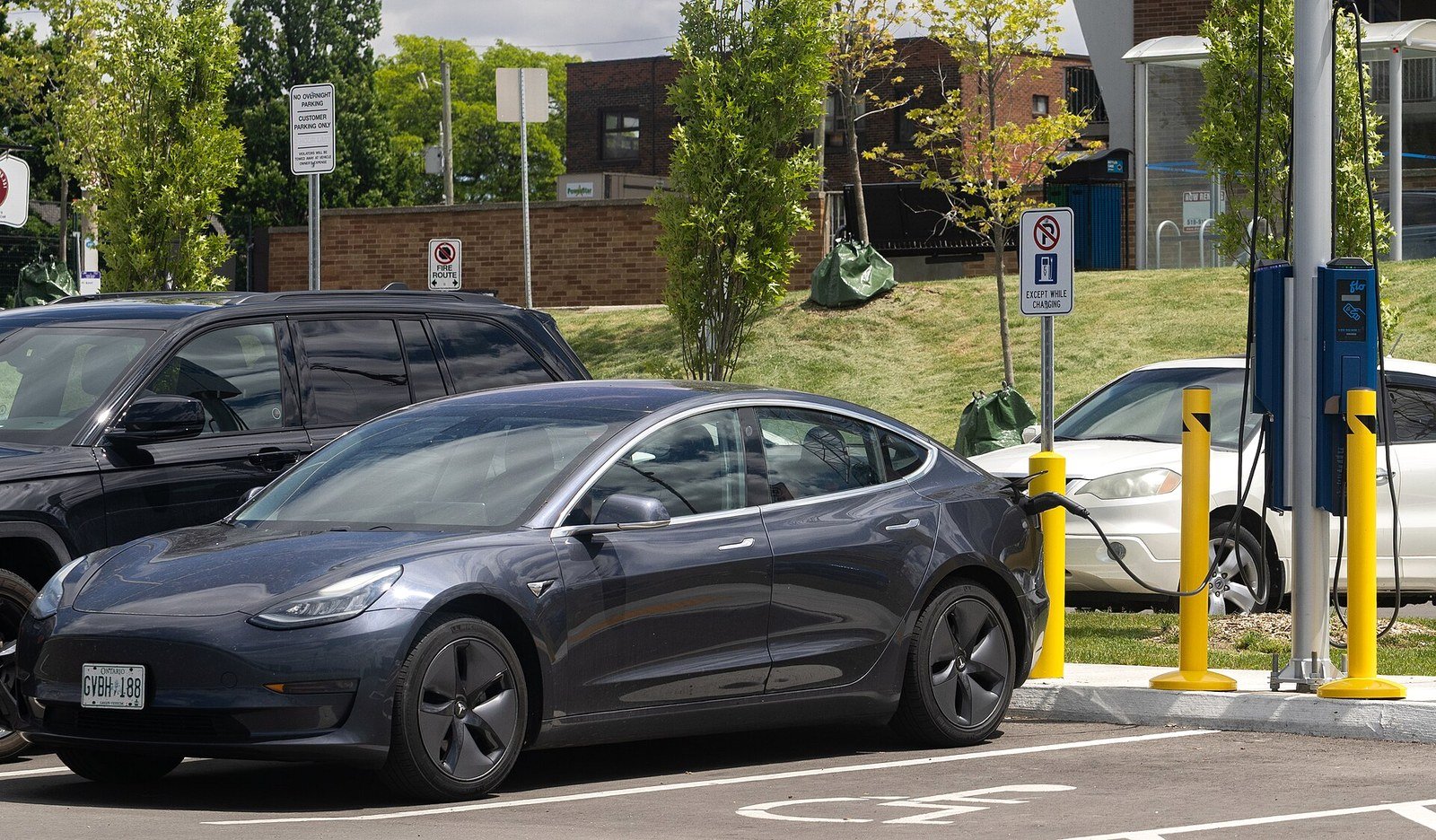
“So it’s basically free to run, right?”
A friend asked me that in a parking lot, standing next to a Model 3 plugged into a public Level 2 post. He had heard the line about pennies per mile, and he wanted to know why his own electricity bill had gone up $60 in a month.
Both things are true, and the thing that separates them is not the car. It is where the cable is plugged in.
So I did the arithmetic properly this week — EPA efficiency for the 2026 cars, the actual residential price of a kilowatt-hour in each state, and what the big fast-charging networks are charging in November 2026. Everything below is measured the same way: dollars per 100 miles, then multiplied out to a 15,000-mile year.
The short version: at home, a Model 3 costs about $4.48 to move 100 miles. At a fast charger on the standard rate it costs $14.78 to $15.99. For the same 100 miles, a 51-mpg Camry hybrid costs $7.14.
The two numbers that decide everything
An EV’s fuel bill has two inputs and nothing else: how many kilowatt-hours it burns per 100 miles, and what a kilowatt-hour costs you.
The first one is fixed by the car, and the EPA publishes it. The 2026 Model 3 Premium RWD uses 24.6 kWh per 100 miles combined (137 MPGe, 363 miles of rated range). A 2026 IONIQ 5 RWD uses 30.0. A three-row IONIQ 9 RWD uses 37.0.
The second one is entirely your situation. And it varies by a factor of three inside the same country.
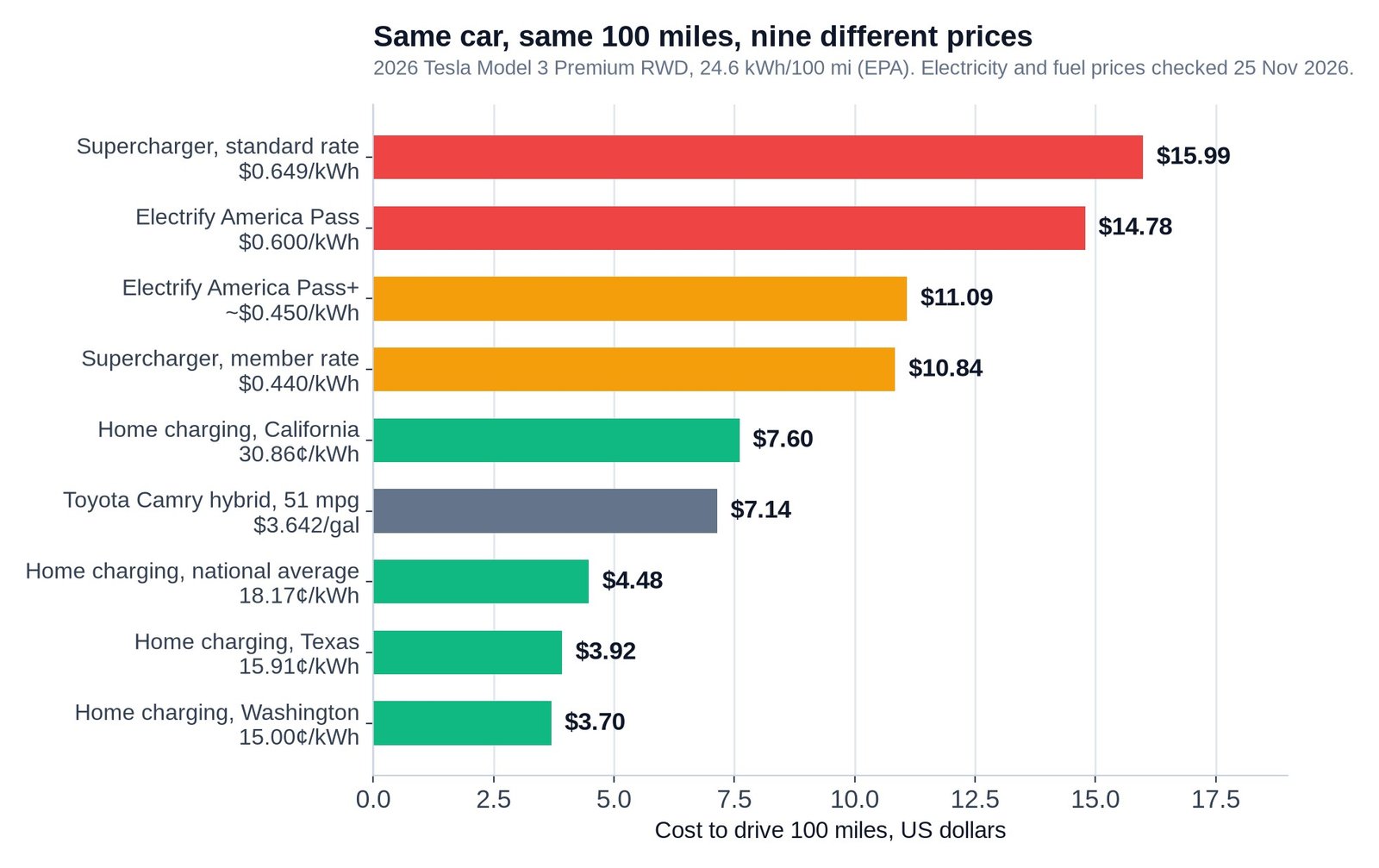
Two things jump out of that chart. The first is the gap between green and red: fast charging is roughly three times the cost of home charging. The second is that a hybrid sedan sits in the middle of the field, and it beats every fast-charging number on the page.
That is not an anti-EV argument. It is an argument about where you plug in.
Your state decides more than your car does
The Energy Information Administration released September 2026 electricity prices on November 24, so these are about as current as national data gets. Average US residential price: 18.17 cents per kWh. Washington: 15.00. Utah: 13.41. California: 30.86. Massachusetts: 30.97. Hawaii: 48.31.
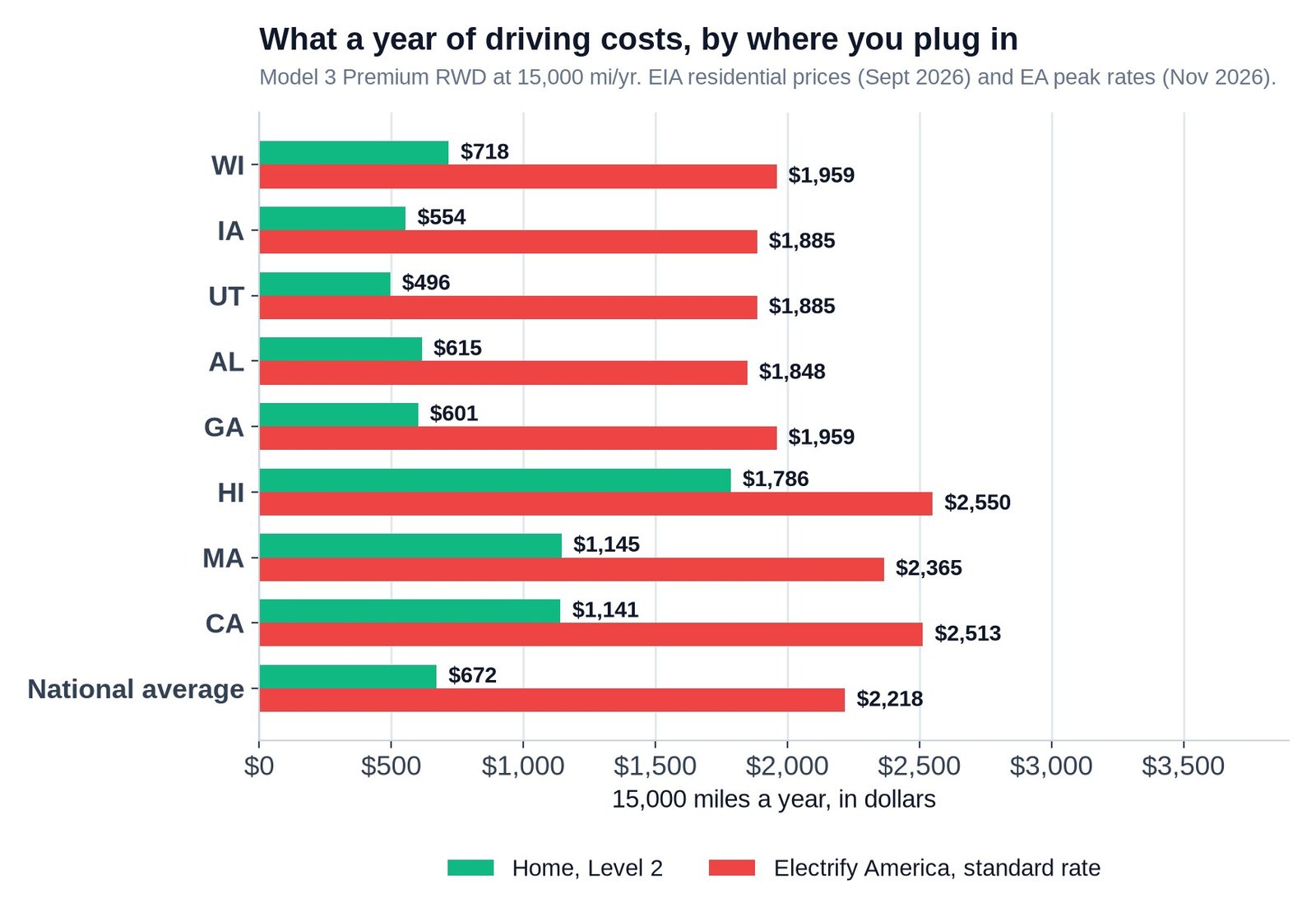
Multiply those by the car’s 24.6 kWh/100 mi and a year of 15,000 miles, and the spread is not a rounding error:
| State | Home ¢/kWh |
Home $ per 100 mi |
EA fast $ per kWh |
EA fast $ per 100 mi |
15,000 mi home / fast |
|---|---|---|---|---|---|
| US average | 18.17 | $4.48 | $0.600 | $14.78 | $672 / $2,218 |
| Utah | 13.41 | $3.30 | $0.51 | $12.56 | $496 / $1,885 |
| Iowa | 14.99 | $3.69 | $0.51 | $12.56 | $554 / $1,885 |
| Georgia | 16.27 | $4.01 | $0.53 | $13.06 | $601 / $1,959 |
| Wisconsin | 19.42 | $4.79 | $0.53 | $13.06 | $718 / $1,959 |
| California | 30.86 | $7.60 | $0.68 | $16.76 | $1,141 / $2,513 |
| Massachusetts | 30.97 | $7.63 | $0.64 | $15.77 | $1,145 / $2,365 |
| Hawaii | 48.31 | $11.90 | $0.69 | $17.00 | $1,786 / $2,550 |
Read the Utah and Hawaii rows together. In Utah, home charging is a fifth of what fast charging costs. In Hawaii, the home rate is so high that the difference is only about 30% — and home charging there costs more per 100 miles than fast charging does in Alabama.
“Charge at home, it’s cheap” is a national-average statement. In Honolulu it is a much weaker statement than in Salt Lake City.
What the fast-charging networks are actually charging
Here is where most comparisons go soft, because no network publishes one national price. Electrify America says plainly that pricing is station-specific and shown in the app or on the charger. Tesla works the same way, with one extra twist: Tesla drivers pay a lower member rate automatically, and other drivers can buy into it.
The November 2026 numbers, tracked station by station and current to November 24:
Tesla Supercharger: $0.649/kWh average standard rate, $0.440/kWh average member rate. That is a $0.209 gap, about 32%. For a non-Tesla owner the mandatory membership is $12.99/month, which pays for itself past roughly 62 kWh a month — about 250 miles in a Model 3.
Electrify America: $0.600/kWh average across 1,206 tracked sites, down 2.4% on October. Pass+ costs about $7/month and takes roughly 25% off, which works out to $0.45/kWh and breaks even past about 47 kWh a month — roughly 190 miles.
EVgo: $0.639/kWh average. Pilot Flying J: $0.588/kWh average.
So the realistic spread for a driver who signs up for the right membership is $0.44 to $0.60 per kWh, and $0.65 to $0.70 if you just tap a card and drive off.
The membership is the whole argument. On a Model 3, the difference between paying $0.649 and $0.440 per kWh is $5.15 per 100 miles — about $772 a year at 15,000 miles. If you fast-charge more than roughly 190 miles a month, skipping the membership is the most expensive mistake in this article.
The thing on the garage wall, priced honestly
A Level 2 charger is not free, and as of July 1, 2026 it no longer comes with a federal subsidy. Section 30C of the tax code — 30% of the cost, up to $1,000 for a home charger — stopped applying to property placed in service after June 30, 2026. The IRS says so in the current Form 8911 instructions, and the Alternative Fuels Data Center now lists the credit as expired.
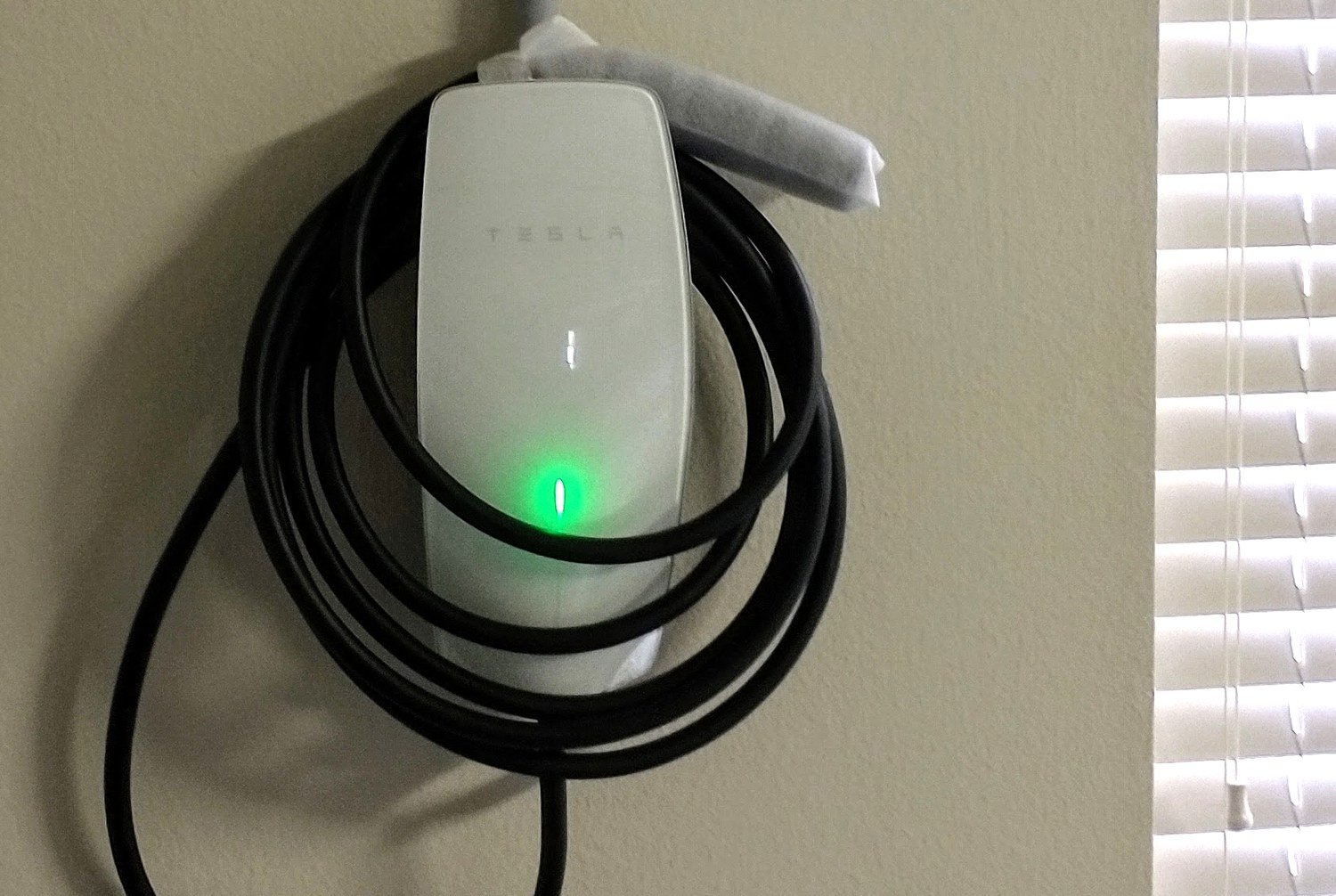
Hardware first. Tesla’s own shop prices the Wall Connector at $635, the Universal Wall Connector (with a J1772 adapter for non-Tesla cars) at $720, and the Mobile Connector, the portable 240-volt cable, at $300.
Installation is the part that surprises people. The Department of Energy’s Idaho National Laboratory looked at more than 4,800 real residential installations and found a median cost of $1,098 and an average of $1,310, with 45% of jobs under $800. NREL’s national charging-network study puts installation at $500 to $1,700 per port and hardware at $400 to $1,200. A service panel upgrade, when one is needed, added about $2,600.
| What you install | Hardware | Install | Total |
|---|---|---|---|
| Mobile Connector into an existing 240 V outlet | $300 | $0 | about $300 |
| Wall Connector, typical hardwired job | $635 | $1,098 median | about $1,733 |
| Wall Connector with a panel upgrade | $635 | $1,098 + $2,600 | about $4,333 |
| Universal Wall Connector, non-Tesla car | $720 | $1,098 median | about $1,818 |
Forty-five percent of installs come in under $800, so a quoted $3,000 is not automatically a rip-off and not automatically fair either. Ask what the distance from the panel is: the same study found roughly $12 per foot of additional run, and about $92 more for every kilowatt above 4 kW.
Does it pay for itself? Usually in about a year
Take the typical $1,733 job and compare it with fast charging at Electrify America’s national average, which is what you would be doing without it.
A 15,000-mile year in the Model 3 is 3,696 kWh. At 18.17¢ that is $672. At $0.600 it is $2,218. The saving is $1,546 a year, so the wall charger pays for itself in about 13 months.
That is the national-average case. In Utah it is faster — $496 against $1,885 — and in Hawaii it is much slower: $1,786 against $2,550, a $764 saving that takes 27 months to repay a $1,733 install.
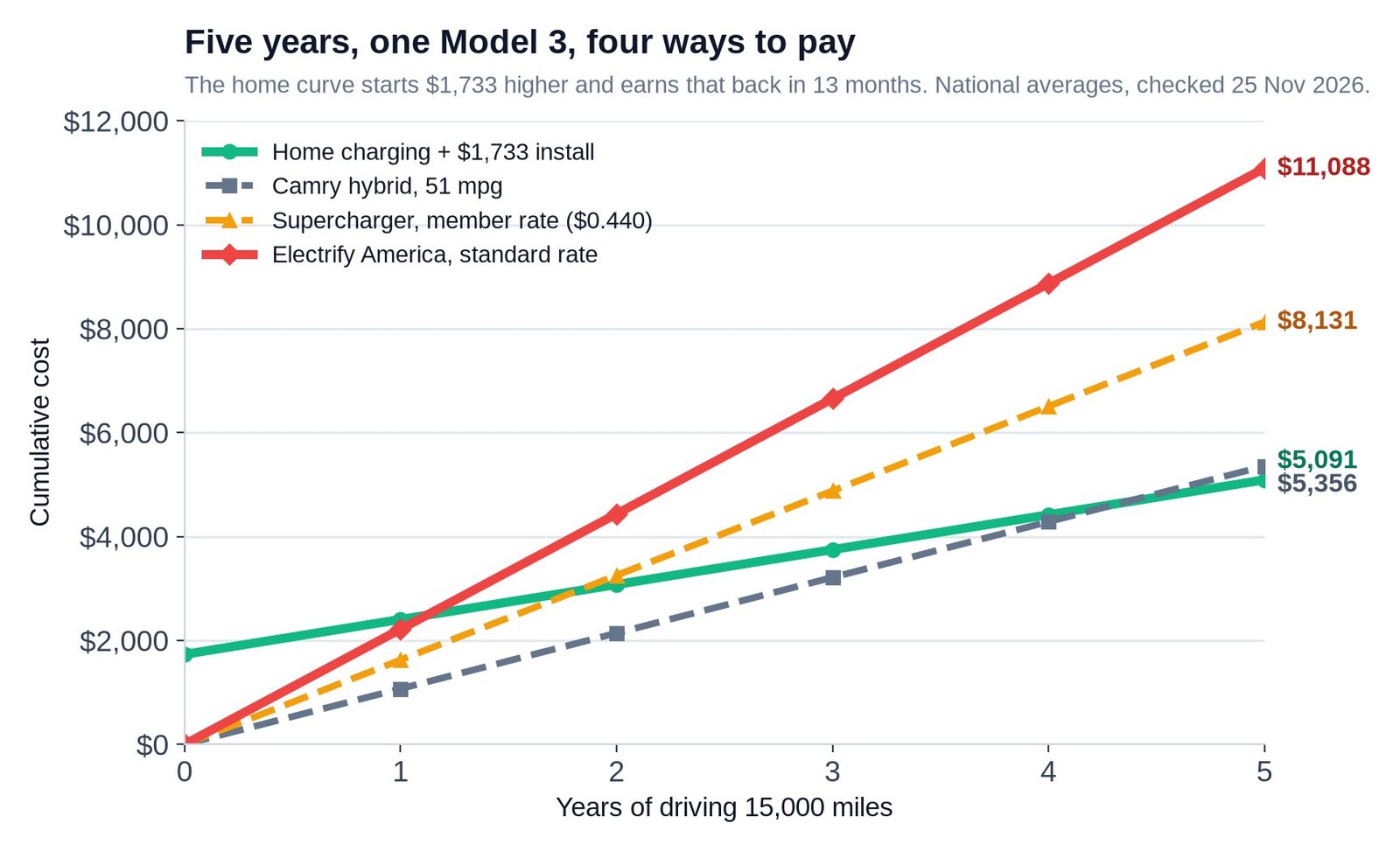
Look at where the green and grey lines finish: after five years, home charging plus a $1,733 install costs $5,091, and a 51-mpg Camry hybrid costs $5,356. Two different cars, two different fuels, same money.
The red line is the one that should worry anyone who bought an EV without a place to plug it in. Five years of standard-rate fast charging is $11,088 — more than twice the home bill, and the one case where the EV is clearly the expensive way to buy miles.
If you cannot charge at home, read this twice
Plenty of American households rent, and many of them have no outlet where they park. For that driver the honest math looks different, and it changes the car recommendation.
On standard fast-charging rates, the Model 3 costs $2,218 a year for 15,000 miles. A 2026 Camry hybrid — 51 mpg combined, no plug — costs $1,071 at $3.642 a gallon. A 32-mpg Honda Accord costs $1,700.
Even on the best public rate in this article, the $0.440 Supercharger member rate, the Tesla lands at $1,626 — still 50% more than the hybrid.
The uncomfortable sentence. If every mile you drive is a fast-charging mile, an efficient hybrid is cheaper to fuel than a Model 3 — unless your employer, your apartment or your carmaker is paying for some of the electrons. Several automakers, Hyundai and Kia among them, bundle complimentary Electrify America charging with new cars, and that changes the arithmetic for the first couple of years.
What flips it back is any regular access to a 240-volt outlet you do not pay retail for: a workplace charger, a landlord who installs one, an overnight garage spot. Two hundred home-charged miles a week is worth more than a thousand fast-charged ones.
What each setup buys you in time
Money is half of this. The other half is how long you stand around.
| Setup | Power | Range added per hour | Hours for 300 miles |
|---|---|---|---|
| Level 1, household outlet | 1.4 kW | about 6 mi | about 51 |
| Level 2, 32 A (40 A breaker) | 7.7 kW | 25–30 mi | about 9.6 |
| Level 2, 48 A (60 A breaker) | 11.5 kW | up to 44 mi | about 6.4 |
| DC fast, 150–350 kW | 150–350 kW | hundreds, then it tapers | 20–40 minutes, in practice |
The 32-amp row is the one most people actually get. Tesla’s own footnote says the Model 3 RWD and both Model Y RWD and AWD trims top out at 32 amps, 7.7 kW — about 30 miles of range an hour — even on a 48-amp Wall Connector. ChargePoint’s published table for the Home Flex lands in the same place: 25 miles an hour at 32 amps, 30 at 40, 36 at 48.
Which means the expensive 60-amp circuit that gets quoted to you sometimes buys nothing on a base car. Ask what your car can accept before you ask what the panel can give.
And the honest framing on Level 1: 6 miles an hour is 70 miles overnight. If you drive 30 miles a day, the outlet that came with the house is enough, and the $1,733 buys convenience rather than capability.
What I would do with this
Drive 12,000+ miles a year with a driveway. Install the Level 2. At $1,733 and a 13-month payback, it is the least glamorous high-return thing you will buy for the car. Get two quotes and ask specifically about the panel.
Drive 5,000 miles a year. Do the payback math before the electrician arrives. At that mileage the national saving is about $515 a year, so a $1,733 install takes more than three years — and if you mostly use a free workplace charger, it never pays back at all.
Rent, with no outlet. Price the hybrid honestly, then check two things: whether your building is adding chargers, and whether the car you want comes with a complimentary charging plan. Buy the membership on day one either way.
Already charging in public. Sign up for the plan that matches the network you actually use. At 15,000 miles a year the difference between the standard and member rate on the Supercharger network is about $772, and the membership costs $12.99 a month.
The comparison, in one table
| 2026 vehicle | EPA kWh/100 mi | Home, 15k mi | Supercharger member | EA standard |
|---|---|---|---|---|
| Model 3 Standard RWD | 24.3 | $662 | $1,604 | $2,187 |
| Model 3 Premium RWD | 24.6 | $672 | $1,626 | $2,218 |
| Model Y Standard RWD | 25.7 | $700 | $1,696 | $2,312 |
| Model Y Long Range AWD | 27.5 | $749 | $1,815 | $2,475 |
| IONIQ 5 RWD | 30.0 | $818 | $1,980 | $2,700 |
| IONIQ 9 RWD | 37.0 | $1,008 | $2,442 | $3,330 |
| Camry hybrid (51 mpg) | — | $1,071 (gasoline) | — | — |
| Accord (32 mpg) | — | $1,700 (gasoline) | — | — |
Efficiency matters, but it is the small lever. Moving from a Model 3 to a three-row IONIQ 9 adds about $336 a year at home and $1,112 a year at Electrify America. Moving from a garage to a public charger adds roughly $1,500 on the Model 3 alone.
FAQ
Is it cheaper to charge at home or at a Supercharger?
Home, by a wide margin. At national averages a Model 3 costs $4.48 per 100 miles at home and $10.84 to $15.99 in public, depending on membership. The gap shrinks in expensive-electricity states like Hawaii and Massachusetts.
How much does a Level 2 charger cost installed in 2026?
Around $1,700 for a $635 Tesla Wall Connector plus the median $1,098 installation. Cheap jobs run $700–$900, and a service panel upgrade can add about $2,600. There is no federal tax credit anymore — Section 30C ended June 30, 2026 — though state and utility programs still exist.
How much does 15,000 miles cost in a Tesla?
About $672 a year at the US average home rate, $1,626 at Supercharger member rates, $2,398 at the Supercharger standard rate, and $2,218 at Electrify America’s standard rate.
Is fast charging more expensive than gasoline?
Often, yes. At $3.642 a gallon, a 51-mpg hybrid costs $7.14 per 100 miles; a Model 3 at standard fast-charging rates costs $14.78 to $15.99. On member rates it lands at $10.84, still above the hybrid.
Do I need a 48-amp or 60-amp circuit?
Not for a Model 3 RWD or a Model Y. Tesla lists a 32-amp, 7.7 kW maximum for those trims, about 30 miles of range per hour. A 40-amp breaker and a 32-amp setting is often the whole job.
Will a Level 2 charger pay for itself?
At 15,000 miles a year, comparing against standard-rate public charging, usually in 13 to 15 months. At 5,000 miles a year it takes years, and if you charge free at work it may never.
What about my electricity plan?
Worth checking before you buy hardware. Time-of-use and EV-specific rates are offered by many utilities, and shifting charging to overnight hours is usually the cheapest single change available to an EV owner.
Sources
US Department of Energy, fueleconomy.gov — 2026 model-year EPA data for Tesla Model 3 Premium RWD (24.6 kWh/100 mi, 363 mi, 137 MPGe), Model 3 Standard RWD, Model Y Standard RWD, Model Y Long Range AWD, Hyundai IONIQ 5 RWD, IONIQ 9 RWD, Toyota Camry HEV LE (51 mpg combined) and Honda Accord (32 mpg), checked November 25, 2026.
US Energy Information Administration — Electric Power Monthly, Table 5.6.A, average price of electricity by state, September 2026 data, released November 24, 2026 (US residential 18.17¢/kWh).
US Energy Information Administration — Gasoline and Diesel Fuel Update, week of November 23, 2026 (US regular $3.642/gal, California $5.274).
DCFC Tracker — Tesla Supercharger Prices, November 2026 (standard $0.649/kWh, member $0.440/kWh, data as of November 24, 2026) and Electrify America Charging Prices, November 2026 ($0.600/kWh average, state averages, 1,206 sites).
Electrify America — pricing and plans page and published site summary: station-specific pricing, Pass+ at about $7/month with roughly 25% savings, Ultra-Fast 150 kW and Hyper-Fast 350 kW tiers.
Tesla — Wall Connector ($635), Universal Wall Connector ($720) and Mobile Connector ($300) product pages, including the note that Model 3 RWD and Model Y RWD/AWD charge at a maximum of 32 A (7.7 kW), up to 30 miles of range per hour.
ChargePoint — Home Flex installation FAQ, amperage settings and miles of range per hour by amperage.
Idaho National Laboratory (US DOE) — “Breakdown of Electric Vehicle Supply Equipment Installation Costs” (2022): median $1,098, mean $1,310, 45% of residential jobs under $800, ~$12 per foot, ~$92 per kW above 4 kW, service upgrade ~$2,600.
NREL — “The 2030 National Charging Network” (2023): residential Level 2 hardware $400–$1,200 per port, installation $500–$1,700.
Internal Revenue Service — Instructions for Form 8911 (Rev. December 2025) and the Alternative Fuel Vehicle Refueling Property Credit page: the Section 30C credit does not apply to property placed in service after June 30, 2026. Alternative Fuels Data Center lists the credit as expired 06/30/2026.
Photos: “Tesla Model 3 charging, Windsor, Ontario” by Crisco 1492, CC BY-SA 4.0; “Tesla Wall Connector” by Whoisjohngalt, CC BY-SA 4.0; “Electrify America DC fast charging station hub” by Oleg Yunakov, CC BY-SA 4.0 — all via Wikimedia Commons.
WHAT THESE NUMBERS ARE, AND AREN’T
Costs are calculated, not measured: EPA combined kWh/100 mi times the published price of a kilowatt-hour, with no charging losses added on top, because the EPA figure is already measured at the wall. DC fast charging loses slightly less energy than AC charging, so the public-charging numbers here are marginally pessimistic. Prices vary by station, by hour and by plan, and they change monthly — the figures above are dated November 24–25, 2026. Excluded from every total: maintenance, tires, insurance, registration, depreciation and any state or utility incentive you may qualify for. Not purchasing advice; check current prices with the network and your utility before you spend anything.
Free · weekly
Get the EV spec sheet
One email a week: real-world range, charging curves, and running costs for the EVs people actually buy, compared side by side.
Free, no spam. Unsubscribe in one click.