
A reader sent me a screenshot last night with a one-line question attached. It was a winter range chart — his Ioniq 5, 81% of its summer range at freezing — and the question was whether that number should change his plan to buy a second EV for his wife.
My answer was no, but not because the number is wrong. It is right, and it is also the wrong unit. A percentage tells you how far the car goes. It does not tell you what the car costs, and those are different worries.
So I spent tonight converting the two best cold-weather studies of 2026 into dollars. One of them was published yesterday. The other is a laboratory test that nobody has priced out yet. Put together, they say something I did not expect: at 20 °F, where you plug in matters more than what you drive.
Two studies, and why the same car gets two different numbers
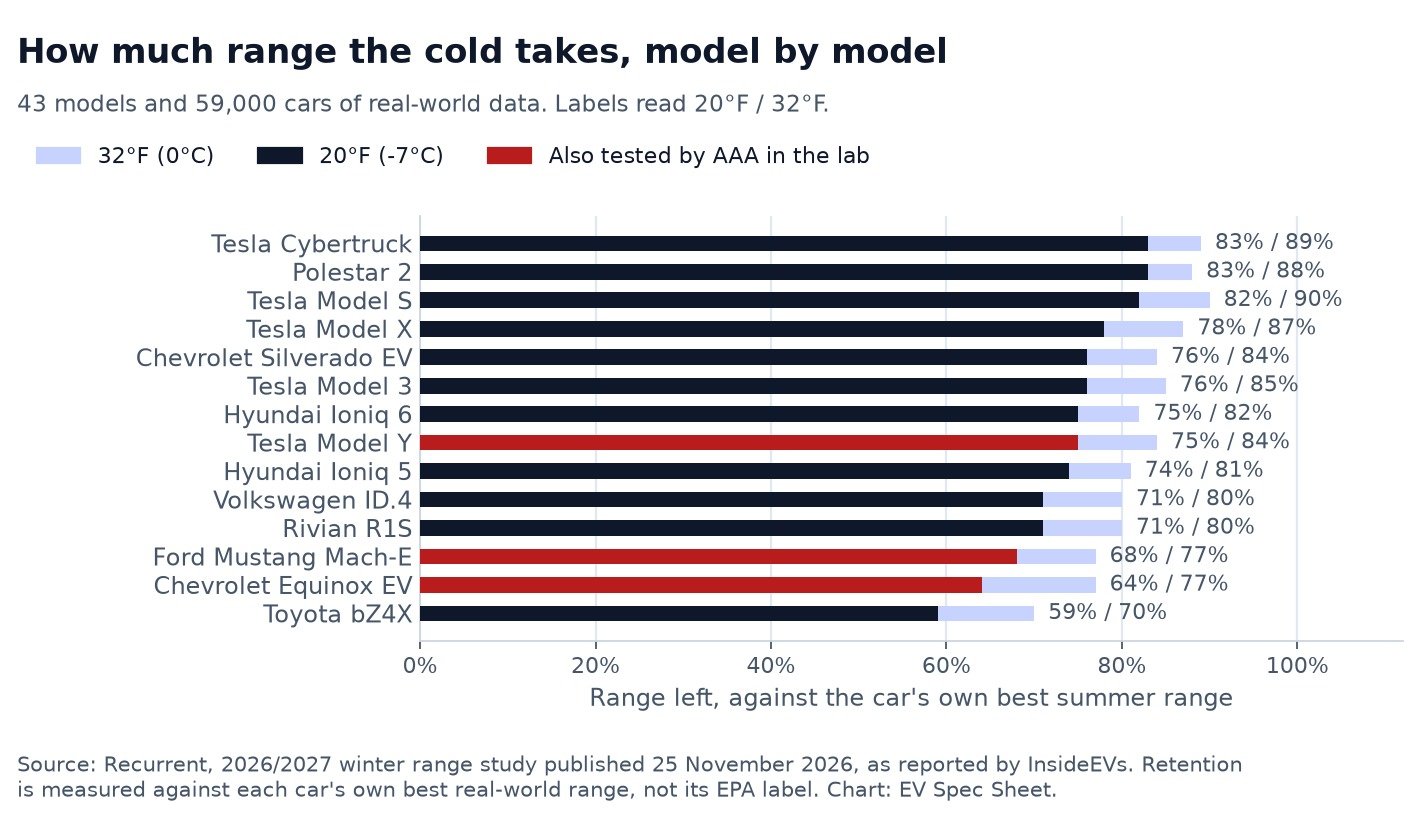
Recurrent published its winter study on November 25, 2026. It covers 59,000 vehicles and 43 models, all from telematics, and it compares each car against its own best range in ideal weather rather than against the EPA sticker.
Its averages: 78% of range at 32 °F, and 69% at 20 °F. The best car keeps 90% at freezing. The worst keeps 70%.
AAA went the other way. In a report released May 1, 2026, its engineers put three EVs and three hybrids on a chassis dynamometer, set the cabin to 72 °F, and ran the test at 20 °F, 75 °F and 95 °F. Same cars, same cycles, one variable.
Its cold results: electric range down 39.0%, electric efficiency down 35.6%, hybrid fuel economy down 22.8%.
| Recurrent | AAA | |
|---|---|---|
| Published | 25 November 2026 | 1 May 2026 |
| Where the data comes from | 59,000 cars in owners’ hands, several winters pooled | 6 cars on a dynamometer, 3 temperatures |
| Measured against | the car’s own best real-world range | the same car at 75 °F |
| Test end of the spectrum | how people actually drive, heaters and garages included | cold start, heater at 72 °F, whole run |
| 20 °F result across the fleet | 31% of range gone | 39% of range gone |
| Tesla Model Y at 20 °F | 75% of range left | 47% of range gone |
That last row is not a contradiction. It is a measurement of two different drivers. Recurrent’s owner preconditions from the app, parks in a garage, does a lot of short trips where the battery is already warm from the last one. AAA’s car sits at 20 °F, starts cold, and runs the heater the entire time.
Both are true. You will meet both this winter.
What 1,000 miles costs at 20 °F
AAA published its own dollar figures, but at March 2026 prices. I have re-priced the same measured energy use at this week’s numbers — 18.17 cents/kWh at home, $0.649/kWh at a Supercharger, $3.642 a gallon — so the cars here are comparable with everything else on this site.
One caveat before the table. AAA’s dyno run is harder on the car than the EPA label suggests: their Model Y used 29.6 kWh per 100 miles at 75 °F against a 25.0 EPA rating for the current rear-drive car. Read the dollars as a shape, not a quote for your commute.
| Car and charging | 75 → 20 °F | Warm | At 20 °F | Adds |
|---|---|---|---|---|
| Mustang Mach-E, home | 35.1 → 44.2 kWh | $64 | $80 | +$17 |
| Toyota Prius | 51.0 → 40.0 mpg | $71 | $91 | +$20 |
| Equinox EV, home | 30.9 → 52.1 kWh | $56 | $95 | +$39 |
| Tesla Model Y, home | 29.6 → 54.6 kWh | $54 | $99 | +$45 |
| Hyundai Tucson Hybrid | 38.4 → 29.5 mpg | $95 | $123 | +$29 |
| Honda CR-V Hybrid | 37.9 → 28.9 mpg | $96 | $126 | +$30 |
| Mustang Mach-E, public | 35.1 → 44.2 kWh | $228 | $287 | +$59 |
| Equinox EV, public | 30.9 → 52.1 kWh | $200 | $338 | +$138 |
| Tesla Model Y, public | 29.6 → 54.6 kWh | $192 | $354 | +$162 |
Here is the sentence I would underline. At 20 °F, a Model Y charged at home costs $99 to cover 1,000 miles. A Toyota Prius costs $91. And the $42 fuel advantage the Model Y has over a CR-V hybrid in mild weather is down to $27.
The hybrids are not immune — every gasoline car in AAA’s test got thirstier — but they lose one bill, not two. Their fuel is the same price at 20 °F as at 75 °F.
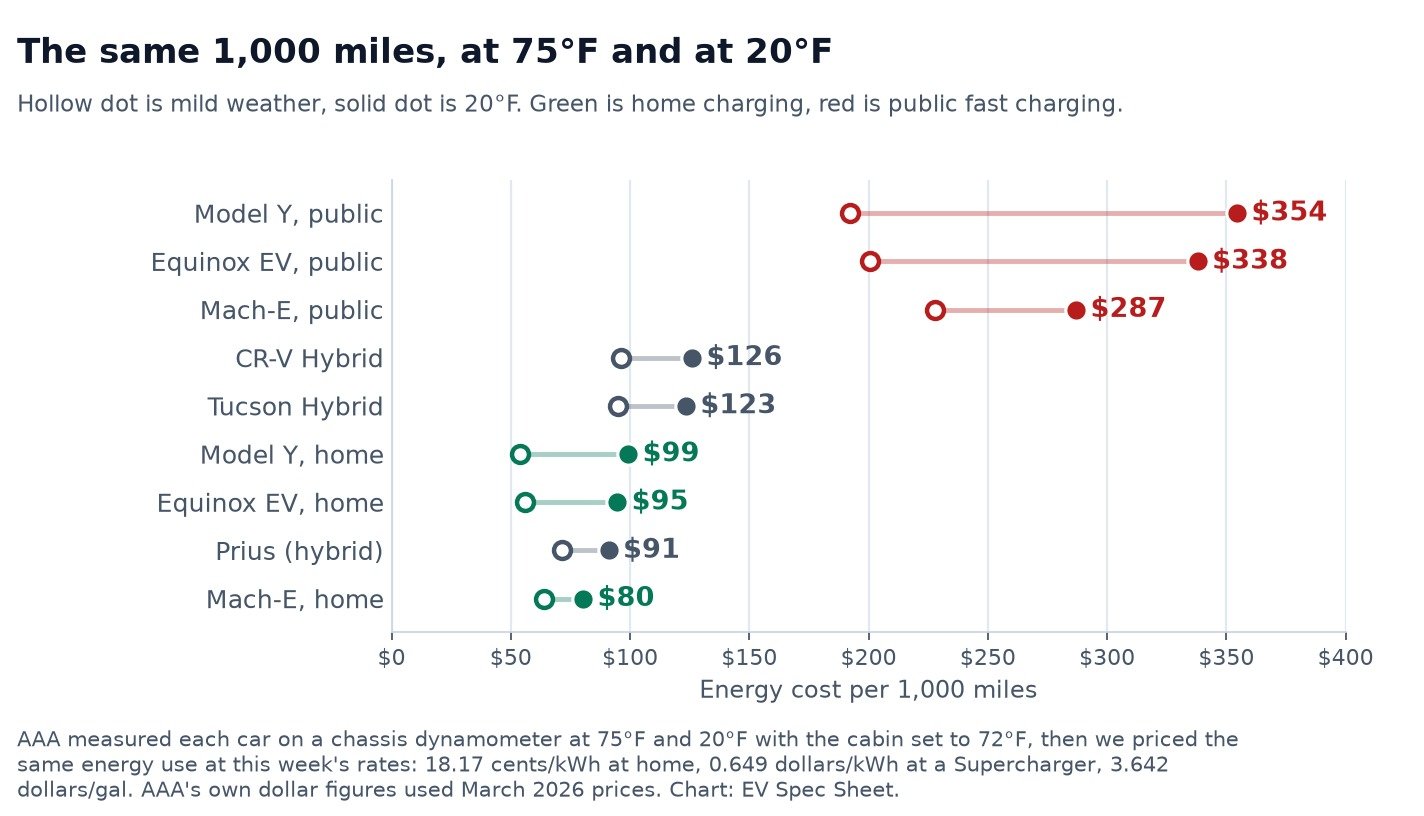
The public-charging rows are the reason this post exists. A Model Y fast-charged at 20 °F costs $354 per 1,000 miles. That is $228 more than the CR-V hybrid beside it, and it is the number that decides whether a winter road trip is cheap or not.
The annual bill, with a winter in it
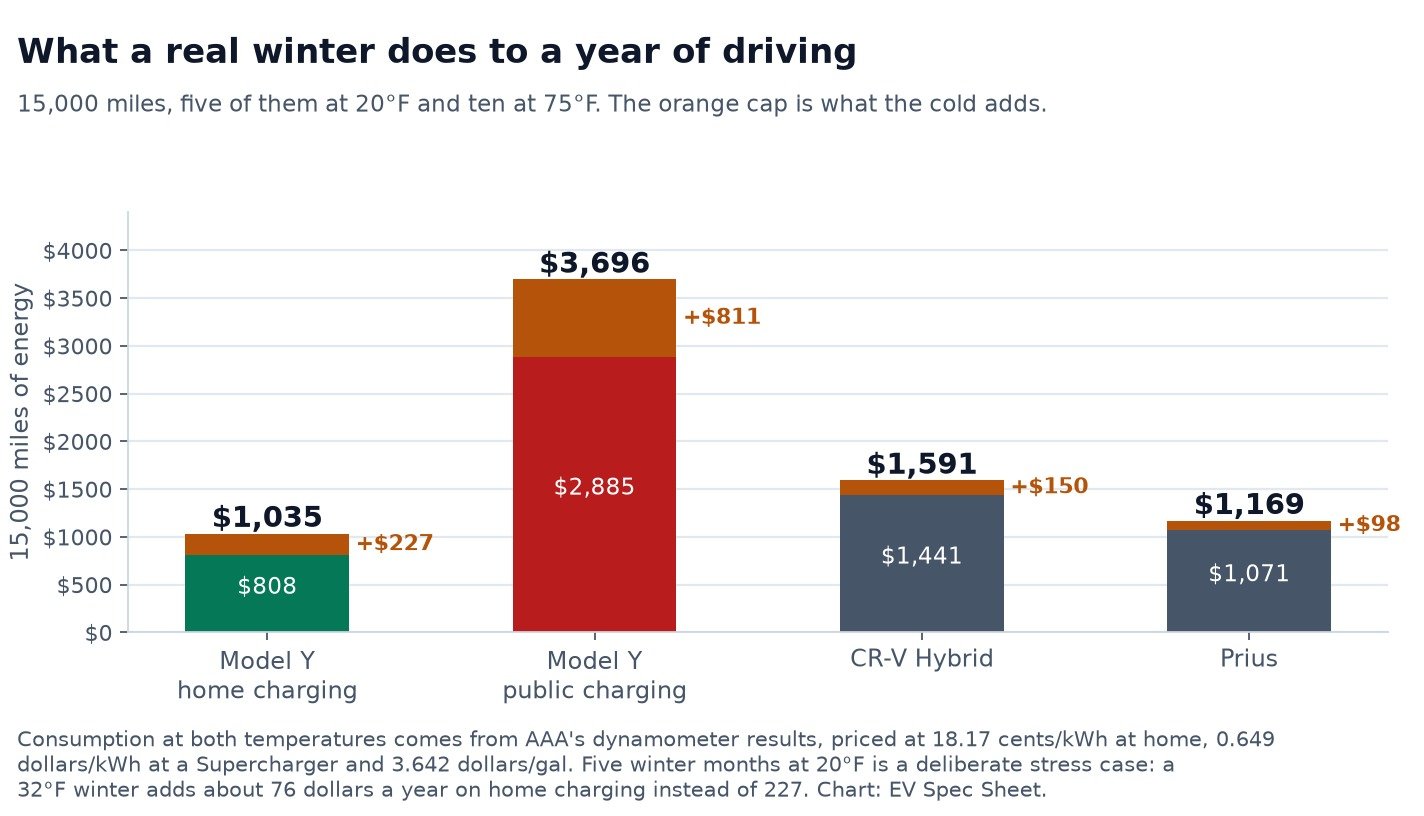
Per-1,000-mile figures are clean but hard to feel. (If you want the warm-weather version of this split, I did it in more detail in the home versus public charging piece.) So here is a year: 15,000 miles, five months of it at 20 °F and the other ten at 75 °F. It is a deliberately hard winter — most people’s January is not a continuous 20 °F — and I say so because the answer moves a lot when you soften it.
| Setup | Mild year | With that winter | Winter cost |
|---|---|---|---|
| Model Y, home charging | $808 | $1,035 | +$227 |
| Equinox EV, home charging | $842 | $1,034 | +$193 |
| Mach-E, home charging | $957 | $1,040 | +$83 |
| Toyota Prius | $1,071 | $1,169 | +$98 |
| Honda CR-V Hybrid | $1,441 | $1,591 | +$150 |
| Model Y, public charging | $2,885 | $3,696 | +$811 |
A hard winter costs a home charger about $227. That is $45 a month for five months, and it is the entire downside of the year for most EV owners. It costs the person who fast-charges everything $811.
Softened to a more typical 32 °F winter, using Recurrent’s 78% fleet figure, the same year costs the home charger $76 extra instead of $227, and the public charger $271 instead of $811.
Why the public column explodes
Two numbers multiply. The first is energy: 45% more of it, per mile, at 20 °F. The second is price: $0.649 a kWh at a Supercharger against $0.1817 at home, which is 3.6 times as much.
Heat a house and the bill goes up. Heat a house and pay 3.6 times the rate and the bill goes somewhere else entirely.
Worth saying plainly: AAA’s “commercial” rate — 41.80 cents/kWh — is a commercial electricity tariff, not what a fast charger charges you. Real DC fast charging in November 2026 averages $0.649, which is 55% higher than AAA assumed. Their public-charging numbers are conservative.
There is a third cost that no table captures: time. A cold pack accepts less power, and many cars deliberately limit charging voltage until it warms, so the car will not pull anywhere near its peak when you plug in on a January morning. Recurrent’s guidance to owners is simply to expect longer stops. If you are on a schedule, that is the part of winter that actually changes your day.
Where the energy goes, and what actually gets it back
The Department of Energy puts a number on the biggest line: about two-thirds of the extra energy an EV burns in the cold goes into heating the cabin. Not the battery, not the tires, not the denser air. The heater.
Which explains the single most useful result in the whole literature. Run the same EV at 20 °F with the cabin heater off, and efficiency falls only 8% and range only 12%, against 39% and 41% with it on.
You cannot drive around all winter with no heat. But you can heat the seats and the wheel instead of the air, and you can heat the cabin while the car is still plugged in, which moves that energy onto the house rate instead of the battery.
The hardware matters too. Recurrent finds a heat pump is worth up to 8 percentage points of range at 32 °F, and their data shows what that looks like on one model: a Model S with the heat pump keeps 90% of its range at freezing, and the same car without one keeps 83%. Below about 0 °F the advantage mostly disappears — a heat pump has little outside heat left to move.
This is also the fairest thing you can say about the Mach-E result. It lost only 25% of its range in AAA’s test while the Model Y lost 47%, and Ford’s 2025 car has a vapor-injection heat pump. I would not read that as “Ford beats Tesla in winter” — Recurrent’s real-world data puts the Model Y ahead of the Mach-E — but as proof that the hardware you buy decides how much this hurts.
The honest counterpoint
Winter is not an electric-car problem. It is a car problem that electric cars happen to answer badly.
AAA’s hybrids lost 22.8% of their fuel economy at 20 °F. The Department of Energy’s figures are worse in town: a conventional gasoline car is about 15% thirstier in city driving at 20 °F than at 77 °F, and as much as 24% thirstier on three- and four-mile trips. Hybrids give up 20% to 40% in the city and 25% to 45% on short runs.
So everybody pays. The EV just pays roughly twice as much in percentage terms, and then pays it again if the charger is a fast one.
What survives the winter is the home-charging case. The same arithmetic is what decided the five-year Model Y versus RAV4 Hybrid comparison, and winter is where the hybrid claws back the most ground. At 20 °F, AAA’s fleet averages put battery-electric cars $36.19 per 1,000 miles cheaper than hybrids at home, and $86.26 more expensive on public charging. That gap — one car, one temperature, two plugs — is the whole argument of this article in one line, and it is why the answer to “is an EV expensive in winter” is “tell me where you park.”
What I would tell the reader with the screenshot
If you can charge at home, buy the EV and stop worrying about January. Your worst case is about $227 a year, and a normal winter is closer to $76. The car is still cheaper to run than the hybrid at 20 °F — $99 against $126 per 1,000 miles — and the range you lose comes back in April.
If you cannot charge at home, this is the one scenario where I would genuinely steer you toward the hybrid. Not because the EV is bad, but because you would be buying the expensive half of the EV bargain and paying for it every winter, at 20 °F, in the dark, at a charger with a line.
If you are in between — a garage sometimes, a road trip twice a year — then plan the trips and stop worrying about the rest. On a 500-mile winter day, budget for one extra stop and check that the chargers you are aiming at are more than 120 miles apart. In a cold snap a 300-mile car is closer to 200, and the gap between “I’ll make it” and “I won’t” is where EV owners get into trouble.
The rest is small and free: precondition while plugged in, use the seat heater, park inside when you can, and check the tire pressures once the temperature drops, because cold tires are soft tires and soft tires cost range.
FAQ
How much range does an EV actually lose at 20 °F?
Across 43 models and 59,000 cars, 31% on average, according to Recurrent’s November 2026 study. The best car kept 83% of its range and the worst kept 59%. In AAA’s controlled test the fleet lost 39%, and the Tesla Model Y lost 47%.
Is the loss permanent?
No. Recurrent is explicit about this: cold-weather range loss is temporary and does no lasting damage to the pack. Range returns as the weather does. What does age a battery is heat and time, not a cold snap.
Is a heat pump worth paying for?
If you live somewhere that spends real time below freezing, yes. Recurrent measures up to 8 percentage points of range at 32 °F, which on a 300-mile car is about 24 miles. Near 0 °F the advantage shrinks to nothing, so the value depends on how cold your cold gets.
Do hybrids and gasoline cars lose range too?
They lose efficiency, not range — the tank is the same size. AAA measured a 22.8% fuel-economy loss at 20 °F for hybrids, and the Department of Energy puts gasoline cars 15% worse in city driving with up to 24% on short trips.
What does winter cost an EV owner over a year?
At 15,000 miles and one hard winter: about $227 on home charging, or $811 if every mile is fast-charged. A typical 32 °F winter brings that down to roughly $76 and $271.
Why is public charging so much worse in the cold?
Because two penalties stack. The car uses about 45% more energy per mile, and public fast charging costs 3.6 times what home electricity does. Multiply them and the per-mile cost more than doubles.
What is the single best thing I can do for winter range?
Precondition the cabin while the car is still plugged in. It is free in the sense that matters — the energy comes from the wall at your rate instead of from the battery you need for the drive — and it also warms the pack, which makes the first miles of the trip cheaper and the next charge faster.
Sources
Recurrent — “Best EV for Winter & Cold Weather Range,” 2026/2027 winter study published November 25, 2026, from 59,000+ vehicles and 43 models (fleet average 78% of range at 32 °F and 69% at 20 °F; best 90%, worst 70%; heat pump worth up to 8% at 32 °F; Model S 90%/82% with heat pump against 83%/76% without; Rivian R1S 80%/71% for 2025 and newer, 77%/69% for 2022–2024). Model-level retention figures as tabulated from the study by InsideEVs, November 25, 2026.
AAA — “Temperature Effects on Electric and Hybrid Vehicle Efficiency,” April 2026 report released May 1, 2026, with the Automobile Club of Southern California Automotive Research Center: 2025 Tesla Model Y, 2025 Ford Mustang Mach-E AWD, 2025 Chevrolet Equinox EV, 2025 Honda CR-V Hybrid AWD, 2025 Hyundai Tucson Hybrid AWD, 2025 Toyota Prius, tested on a chassis dynamometer per SAE J1634 and J1711 at 20 °F, 75 °F and 95 °F with cabin HVAC at 72 °F (BEV fleet −35.6% MPGe and −39.0% range at 20 °F; HEV fleet −22.8% mpg; costs at residential $0.1745/kWh, commercial $0.4180/kWh and gasoline $3.978/gal as of March 27, 2026).
US Department of Energy, fueleconomy.gov — “Fuel Economy in Cold Weather,” based on Oak Ridge National Laboratory analysis of EPA test results (gasoline −15% in city driving at 20 °F versus 77 °F, up to −24% on 3–4 mile trips; hybrids −20% to −40% city and −25% to −45% short trips; EV economy −39% and range −41%, about two-thirds of the extra energy going to cabin heat; EV without cabin heat −8% economy and −12% range), checked November 26, 2026.
US Energy Information Administration — Electric Power Monthly, September 2026 data (US residential average 18.17¢/kWh) and Gasoline and Diesel Fuel Update, week of November 23, 2026 (US regular $3.642/gal).
DCFC Tracker — Tesla Supercharger prices, November 2026 (standard $0.649/kWh, member $0.440/kWh).
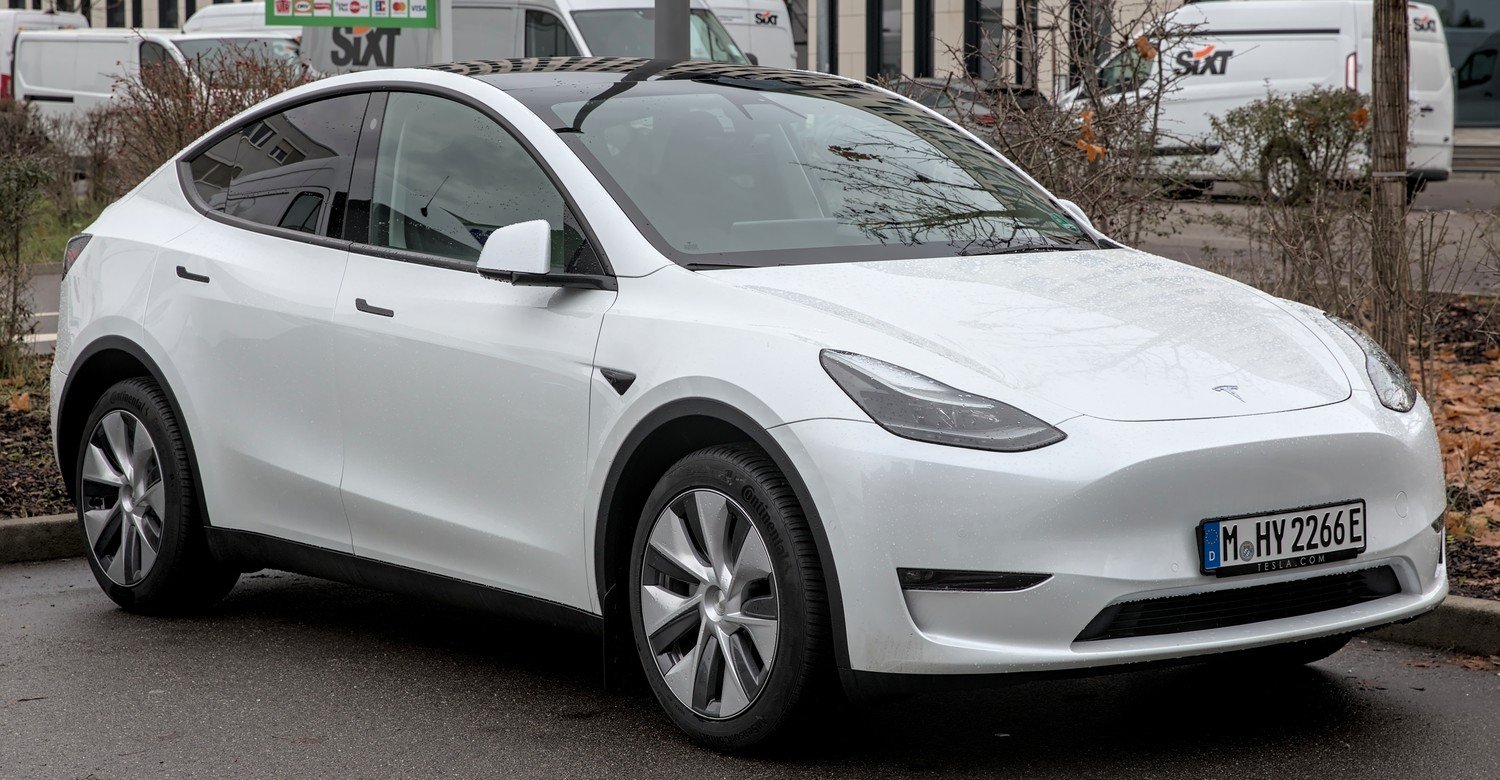
Photos: “Chuncheon, Gangwon Province, South Korea — charging stations in the snow” by Sharon Hahn Darlin, CC BY 2.0; “Tesla Model Y” by Alexander Migl (Alexander-93), CC BY-SA 4.0; “Fast Charging Station in Snow” by WindBorneListener, CC0 — all via Wikimedia Commons.
WHAT THESE NUMBERS ARE, AND AREN’T
AAA’s figures come from one car per model on a laboratory dynamometer, not from your car on your road. Their 20 °F test starts cold and holds the cabin at 72 °F for the entire run, which is harder on a battery than a warmed-up highway trip and gentler than a freezing commute with the defroster on. Recurrent’s figures are averages from owners who opted in, so they skew toward people who care about this. The dollar columns are our arithmetic on their energy measurements, priced at November 2026 national averages — your electricity rate, your gasoline price and your state’s weather will move every one of them. Gasoline prices are the same for warm and cold in this model, which flatters the hybrids slightly, since winter blends carry a little less energy per gallon. Prices and studies are dated November 26, 2026. Not purchasing or financial advice.
If this kind of line-by-line math is useful to you, the box below puts each new one in your inbox — one email, no noise, and you can leave whenever it stops being useful.
Free · weekly
Get the EV spec sheet
One email a week: real-world range, charging curves, and running costs for the EVs people actually buy, compared side by side.
Free, no spam. Unsubscribe in one click.
Keep reading
5 more from the site Charging & Ownership CostsModel Y vs RAV4 Hybrid: Over Five Years the Bill Is $21,000 Apart, and Fuel Isn’t Why
 Charging & Ownership CostsHome Charging vs Public Fast Charging in 2026: What 15,000 Miles Actually Costs
 Autonomous DrivingFSD v15.0.1 Is Here for Early Access: Reality View, Speed Cameras, and What HW3 Cars Get Instead
 Tesla NewsThe Cybertruck Ends With One Trim, a $112,235 Sticker and a Very Strange Week
 Tesla NewsTesla’s Cheapest Model Y Now Goes 348 Miles, and the AWD It Replaced Costs $8,000 More