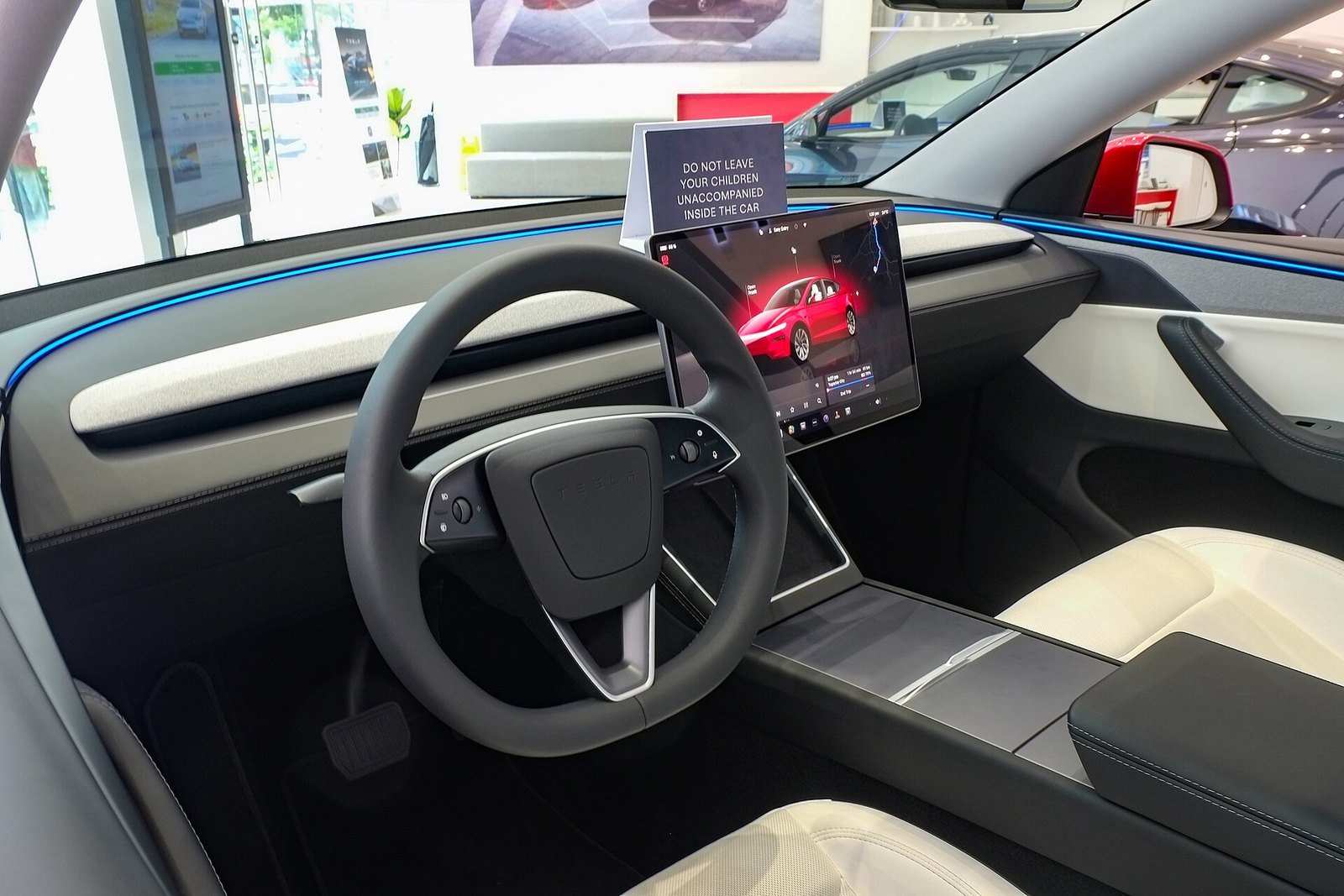
In January, Tesla announced it would stop selling Full Self-Driving outright. On February 14, 2026, the $8,000 buy-it-once option disappeared from the configurator, and the only way to get FSD on a new Tesla became $99 a month, forever, cancellable, and attached to you rather than to the car.
That single decision changed the arithmetic of this whole category. Ford and Rivian still let you buy the software once. Tesla doesn’t. So the question “subscription or one-time purchase?” — the one every driver-assistance article used to end with — now has a different answer depending on which badge is on your driveway.
Here’s what each system costs on November 24, 2026, what it will actually do, and where the money stops making sense.
Four systems, and only three of them are things you can buy
Worth clearing this up first, because the comparison gets muddled everywhere else: Waymo is not a competitor to FSD. It’s a taxi company. You don’t buy anything, you hail a car, and the software never touches your own vehicle. It belongs in this conversation only because it’s the thing people actually mean when they say “self-driving” — and because it shows how far the purchased systems still are from it.
| 2026, official terms | Tesla FSD (Supervised) | Ford BlueCruise | Rivian Autonomy+ | Waymo |
|---|---|---|---|---|
| Monthly | $99 | $49.99 | $49.99 | — |
| Yearly | — | $495 | — | — |
| One-time | Not offered since Feb 14 2026 (was $8,000) | $2,495, dealer only, at purchase | $2,500, stays with the vehicle | — |
| Free trial | 1 month with a new car | 90 days | 60 days | — |
| Where it works | City streets and highways, where regulators allow it | 130,000 miles of divided highway “Blue Zones” — Ford says 97% of controlled-access highways | 3.5 million miles of US and Canadian roads with clear lane markings | 13 metro areas; no personal-car product |
| Hands | Hands-off, but the car nags for attention | Hands-off in a Blue Zone | Hands-off on marked lanes | Nobody in the driver’s seat |
| Eyes | On the road; camera-monitored | On the road; driver-facing camera | On the road | N/A |
| Stops for lights and stop signs | Yes | Not on city streets — highway only | No. Rivian states Universal Hands-Free “will not stop or slow down for traffic lights or stop signs” | Yes |
| Transfers with the car | No — subscription follows the account | One-time purchase does | One-time purchase does | N/A |
That last row is the one nobody talks about at the dealership, and it’s worth real money. A $2,500 Autonomy+ purchase stays with the Rivian when you sell it. A $2,495 BlueCruise purchase stays with the Ford. Three years of Tesla’s subscription — $3,564 — stays in Tesla’s pocket and leaves with you.
Three years is the number that matters
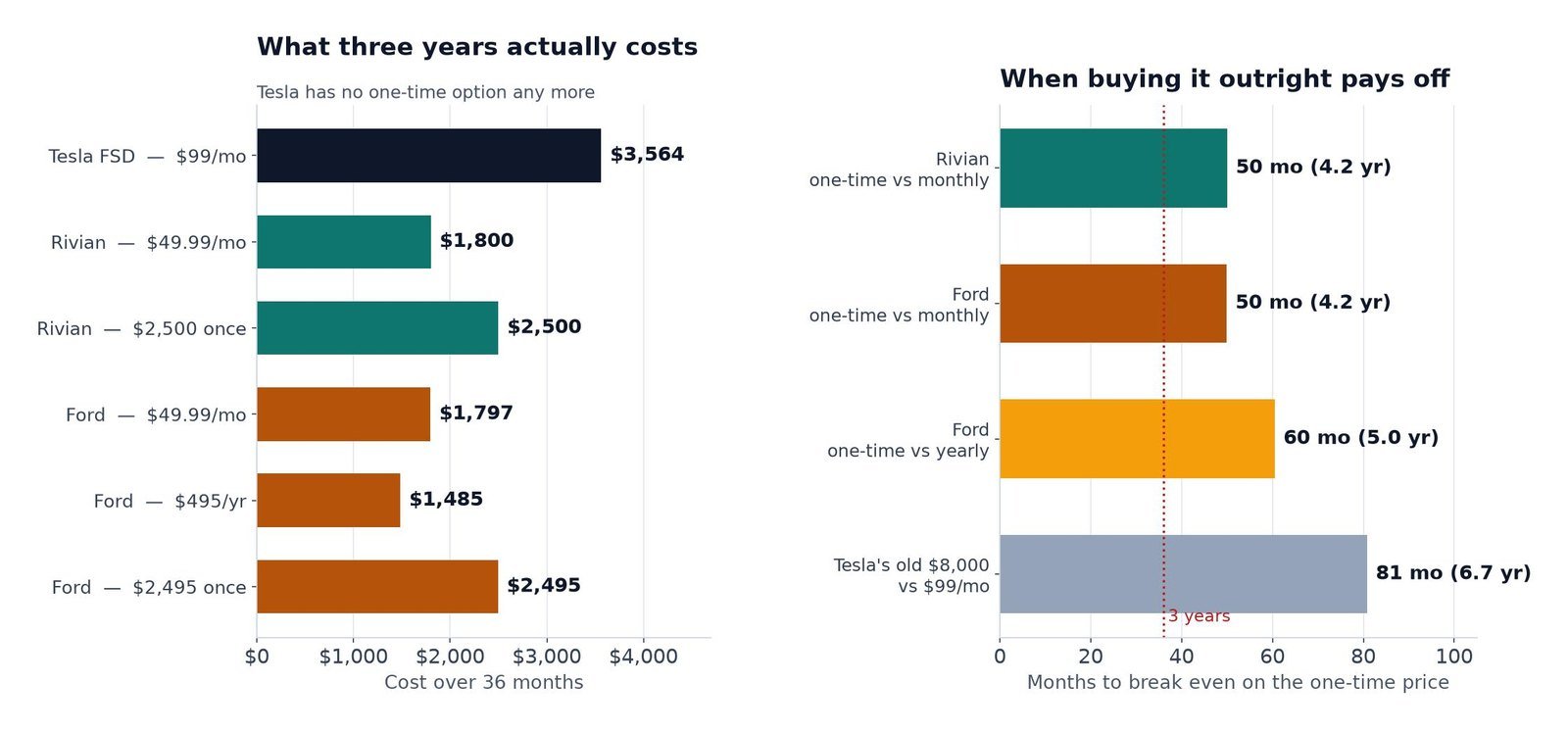
Most people keep a new car for somewhere between three and six years, which makes the three-year mark the point where this decision stops being academic. Here’s the same three-year window for every plan that exists today:
| 36 months | Cost | What you end up with |
|---|---|---|
| Tesla FSD, $99/mo | $3,564 | Nothing to sell. Cancel and it’s gone. |
| Rivian Autonomy+, monthly | $1,800 | Same: nothing to sell |
| Rivian Autonomy+, one-time | $2,500 | A paid-up vehicle that’s worth more to a buyer |
| Ford BlueCruise, monthly | $1,797 | Nothing to sell |
| Ford BlueCruise, yearly | $1,485 | Nothing to sell — but the cheapest path of all |
| Ford BlueCruise, one-time | $2,495 | A paid-up vehicle |
Ford’s yearly plan is the quiet bargain here. $495 a year is $41.25 a month, and if you’re the sort of person who only wants hands-free driving for the summer road trip, you can buy one year and skip the next two.
So when does buying outright pay off?
Rivian’s $2,500 against $49.99 a month breaks even at 50 months, just past four years. Ford’s $2,495 against $49.99 also lands at 50 months; against the $495 yearly plan it takes 60 months, five years. Both are sensible purchases if you plan to keep the car — and both are the rare case where spending more today is the cheaper choice, because the software stays bolted to the vehicle.
Tesla’s old $8,000 would have taken 81 months — nearly seven years — to beat $99 a month. That’s my best guess at why Tesla killed it: almost nobody keeps a car that long, and the company would rather have $1,188 a year from everyone than $8,000 from 12% of buyers.
There’s a flip side to subscription-only that deserves saying out loud. If Tesla raises the price, you either pay it or lose the feature. Musk has said publicly that the $99 will rise as the software improves. With a one-time purchase, the price you paid is the price you paid.
The part that decides it: where the thing actually works
This is where the spec sheets stop being equal and the marketing starts being misleading.
Ford is the most honest about its limits. BlueCruise works on 130,000 miles of divided highway — Blue Zones — which Ford describes as 97 percent of controlled-access highways in the US and Canada. It will not drive you through town, it will not handle a traffic light, and it watches your eyes with an infrared camera the whole time. What it does, it does on exactly the roads where long drives get tiring.
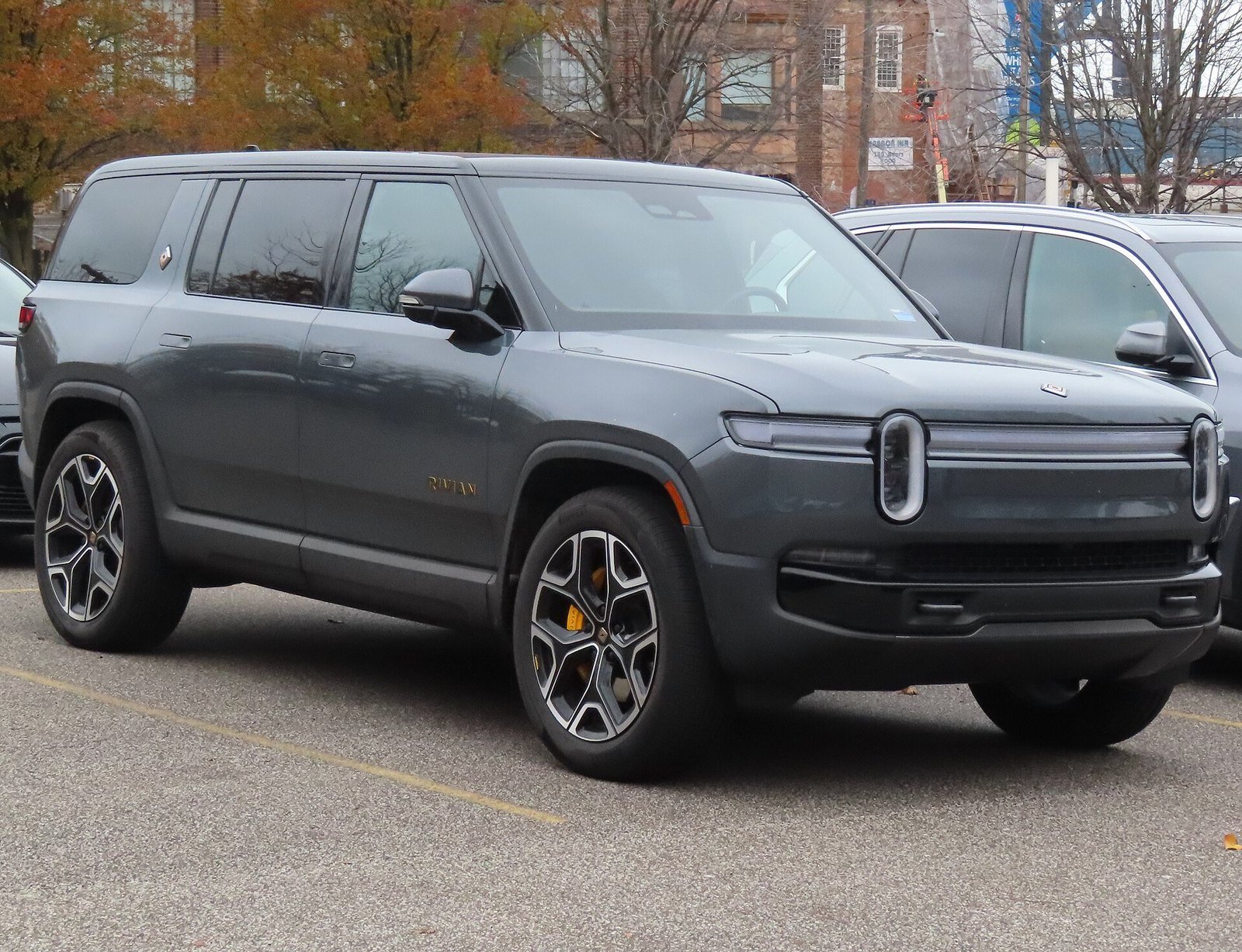
Rivian sits in a strange middle. Universal Hands-Free covers 3.5 million miles of roads, far more than Ford, and it works on ordinary marked lanes rather than only interstates. But Rivian’s own footnote is blunt: the system will not stop or slow down for traffic lights or stop signs. It’s a lane-keeping system that happens to cover a lot of lanes. Point to Point, which follows your navigation and handles turns, is the upgrade that closes that gap, and Rivian is rolling it out over the air.
Tesla does the most: city streets, turns, signals, stop signs, parking, summoning the car across a lot. It also, in the same breath, requires you to keep your eyes up and your hands ready, and prompts you to grab the wheel when it isn’t sure. Tesla’s own disclaimer says the enabled features “require active driver supervision and do not make the vehicle autonomous.” In Europe, Tesla has started splitting the package in two — a cheaper “Tesla Assisted Driving Basic” subscription for parking and summon features, with the full suite separate. Expect more of that unbundling, not less.
And then there’s Waymo, which isn’t the same product at all
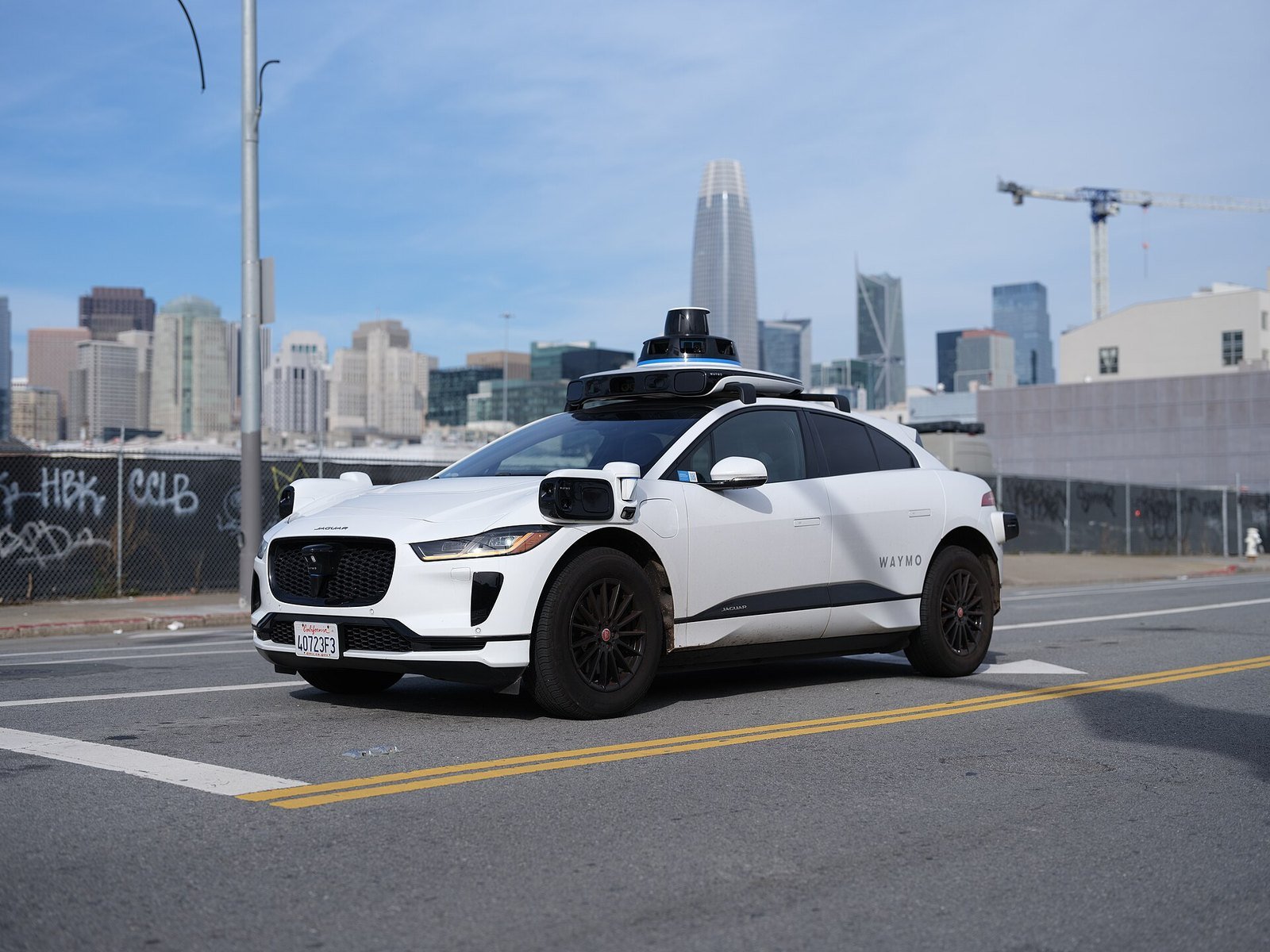
Waymo runs a fully driverless ride-hailing service in 13 metro areas — Phoenix, Los Angeles, San Francisco Bay Area, San Diego, Las Vegas, Denver, Dallas, Houston, San Antonio, Miami, Orlando, Tampa and Nashville — plus Austin and Atlanta through the Uber app. In May 2026 the company said it covers more than 1,400 square miles across 11 cities. The fleet is Jaguar I-PACE, with its newer sixth-generation “Ojai” vehicle rolling out in Phoenix, LA and San Francisco.
You pay per trip. Your first ride could be tomorrow, and you’ll never supervise anything. That’s the honest comparison point: for the price of about three years of Tesla’s subscription — $3,564 — you could take a lot of robotaxi rides in a city where Waymo operates, and none of them require you to keep your hands ready.
What I’d pay for
If you own a Tesla: subscribe for a month when you have a long trip, then cancel. $99 with no commitment is a genuinely good deal for a two-week holiday, and there’s no reason to carry it year-round if your commute is 20 minutes of straight road.
If you’re buying a Rivian and keeping it: the $2,500 one-time. Fifty months is the break-even, the feature stays with the truck, and it’s the only version of this purchase that has any resale value at all.
If you’re buying a Ford: start with the 90-day trial, then decide between $495 a year and $2,495 once. If you’re not sure you’ll keep the car five years, take the yearly plan and stay flexible.
If you want to be driven rather than supervised: none of the three. That’s Waymo, in the cities where it exists, at per-trip prices.
Questions I get asked
Can I still buy FSD outright on a used Tesla?
Tesla stopped selling the one-time option for new cars on February 14, 2026. Older cars that already have it keep it, and some used listings advertise it — verify it on the car’s screen, not the listing.
Did Tesla really kill Autopilot?
Yes. Tesla discontinued Autopilot in January 2026; new cars now come with Traffic-Aware Cruise Control as standard and lane-centering sits behind the FSD subscription.
Does BlueCruise work on any road?
No. Only on divided highways mapped as Blue Zones, and only while the driver-facing camera can see your eyes on the road.
Is Rivian’s Autonomy+ the same as Tesla FSD?
No. Rivian’s hands-free system does not stop for traffic lights or stop signs, and Rivian says so. Tesla’s does, under supervision.
Do any of these make the car autonomous?
None of the three purchased systems. All three require an attentive driver who is legally in control. Waymo’s vehicles are the only ones here operating without a human driver, and you can’t buy one.
Do prices include tax?
No. Tesla’s $99 is billed monthly plus tax; Ford and Rivian prices are before applicable taxes.
Sources
Tesla US design studio, FSD (Supervised) subscription price and one-month trial, checked Nov 24 2026 · Tesla support: Tesla Assisted Driving and Assisted Driving Basic subscription pages (Europe) · TechCrunch, Jan 14 2026, and Reuters, Jan 14 2026 (one-time FSD purchase ending Feb 14) · Business Insider, Feb 16 2026 (removal completed) · TechCrunch and Ars Technica, Jan 23 2026 (Autopilot discontinued) · ford.com/technology/bluecruise and Ford support FAQ (pricing $49.99/mo, $495/yr, $2,495 one-time; 130,000 miles of Blue Zones; 97% of controlled-access highways; 90-day trial) · rivian.com/support/article/autonomy-plus-upgrade and rivian.com/autonomy ($49.99/mo, $2,500 one-time, 3.5 million miles, 60-day trial) · Rivian newsroom, Dec 11 2025 · waymo.com/faq and Waymo service-area help pages (13 metros, I-PACE and Ojai fleet) · Waymo blog, May 13 2026 (1,400 square miles across 11 cities).
How this was checked. Prices and product terms came from Tesla, Ford and Rivian’s own pages on November 24, 2026; the change to Tesla’s one-time purchase was verified against contemporaneous reporting from three outlets. Break-even months and three-year totals are our arithmetic on those prices.
One more warning. All three systems are driver-assistance features, not autonomy. Every manufacturer’s terms require your attention and put legal responsibility on you, the driver. Tesla, Ford and Rivian are not affiliated with this site and none of them paid for this comparison.
Header photo: Ethan Llamas, CC BY-SA 4.0, via Wikimedia Commons.